Well Water — Iron
Iron in Well Water:
the Fix That Actually Holds
Orange stains are a symptom. The fix depends on which form of iron you have — and they respond to treatment differently.
By Tim Parker — Reads the spec sheets and prices the full install
Three types of iron, three different problems
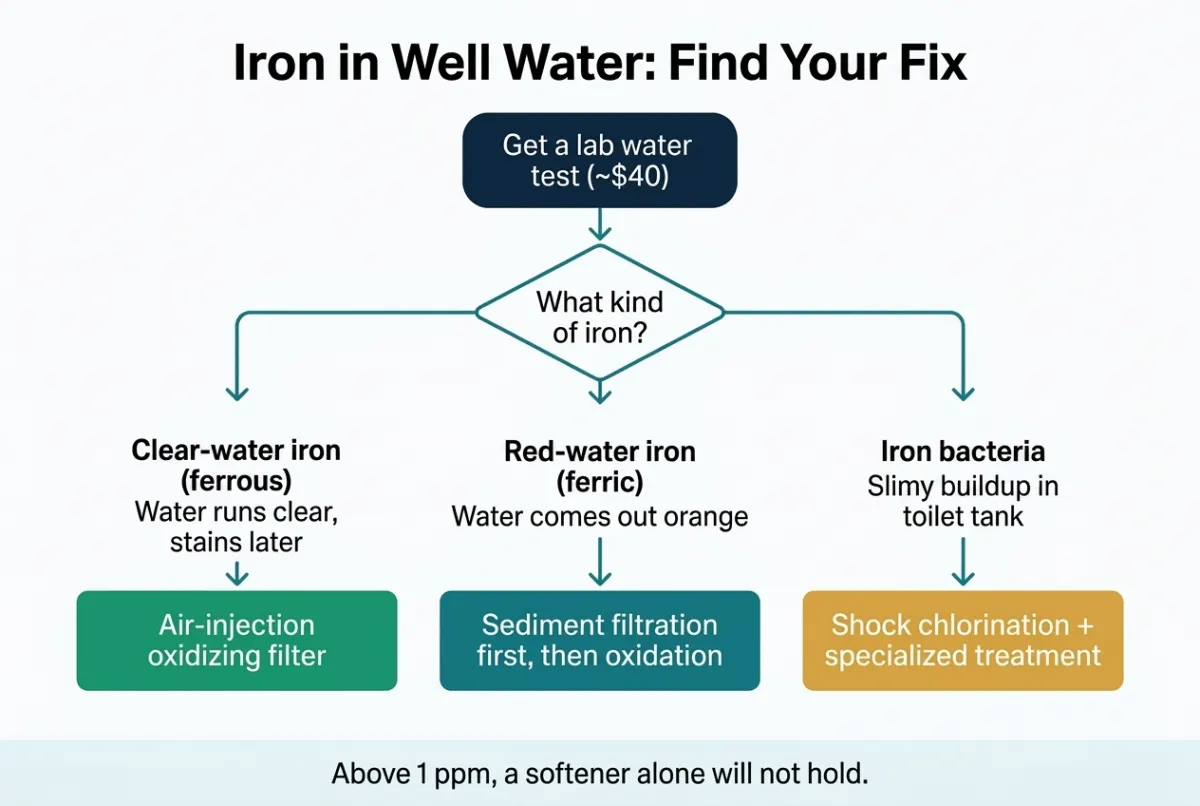
Ferrous iron (clear-water iron) is dissolved. The water looks clear at the tap but turns orange when it sits or contacts air. This is the most common form and the most treatable. Concentrations above 0.3 ppm will stain; above 3 ppm you will notice it in taste as well.
Ferric iron (red-water iron) is already oxidized and particulate — the water comes out visibly rusty or orange. It can be filtered mechanically, but the sediment load clogs standard carbon media quickly. Air-injection systems handle both ferrous and ferric iron in sequence: oxidize first, filter second.
Iron bacteria are microorganisms that feed on iron and leave a reddish-brown slime in toilet tanks and pipes. They are not removed by filtration alone — they require shock chlorination of the well followed by a filter system. If you see slime deposits, test for iron bacteria before selecting equipment; an oxidation filter will not solve it on its own.
Ferrous vs ferric vs iron bacteria: the $40 test that tells you
A standard water panel from your state cooperative extension lab runs $30–$60 and reports iron in ppm, pH, hardness, and usually coliform bacteria. That number — ppm of total iron — is what every equipment manufacturer uses for sizing. Without it, you are guessing.
To distinguish ferrous from ferric iron at home before the lab results arrive: fill a clear glass from the tap. If the water runs clear and turns orange only after sitting 5–10 minutes, it is predominantly ferrous (dissolved). If it runs visibly cloudy or rust-colored from the tap, there is ferric (particulate) iron present as well.
Iron bacteria require a separate specific test — a standard mineral panel doesn't detect them. If you see red-brown slime in toilet tanks, on rubber flappers, or around faucet aerators, order an iron bacteria test from a certified lab ($15–$30 as an add-on). The result changes the treatment protocol completely: iron bacteria wells need shock chlorination before any oxidation filter will hold, and periodic re-treatment may be required if the bacteria recolonize.
Why softeners alone fail above 1 ppm
Water softeners exchange calcium and magnesium ions for sodium — they are not designed for iron removal. The resin beads foul with iron deposits over time, reducing softening capacity and eventually requiring expensive resin replacement. Most softener manufacturers publish an iron tolerance of 1 ppm or lower. If your test shows iron above that threshold, a dedicated iron filter upstream of the softener is required. The iron filter clears the iron; the softener handles hardness. Running them in the wrong order — or skipping the iron filter — shortens the life of both units.
The correct installation sequence: sediment prefilter → iron/sulfur filter → water softener → carbon polish (optional). Each stage protects the one downstream from fouling. Installing carbon before iron removal is the most expensive ordering mistake: the carbon bed fouls with iron at a fraction of its rated life, and you end up replacing a $1,200 system in 18 months instead of 10 years.
How air-injection oxidation works
Air-injection systems maintain an air pocket at the top of the tank during the service cycle. Water passes through the air pocket, which oxidizes dissolved iron and hydrogen sulfide into solid particles. Those particles are then captured by the filter media below. During the backwash cycle, the system flushes the accumulated solids to drain and replenishes the air charge. No chemicals are required. No separate aeration tank is needed. The entire process happens in a single pressure vessel.
The key variable is contact time with the air pocket — which is why tank sizing matters. An undersized tank at high flow rates reduces contact time, lowering oxidation efficiency and allowing iron to pass through. Proper sizing starts with your peak flow demand (GPM) and iron concentration (ppm).
What iron does to fixtures and laundry
Iron staining is not just cosmetic — it is progressive property damage. At 0.3 ppm, staining shows first on white porcelain (toilets, sinks, tubs) as a rust-colored ring. At 1 ppm, laundry develops a permanent orange tint that no detergent removes; fabrics already stained are effectively unrecoverable. At 3 ppm and above, iron precipitates inside water heater tanks and appliance inlet valves, progressively reducing flow and eventually requiring premature replacement.
Dishwashers are particularly vulnerable: iron deposits cloud glassware and build up on spray arm ports, reducing cleaning performance before the appliance fails mechanically. Irrigation systems accumulate visible orange deposits on heads, clogging emitters and staining concrete and siding. A properly sized iron filter eliminates all of these downstream effects by catching the iron before it reaches any fixture.
Sizing by iron concentration
| Iron level (ppm) | Approach | Notes |
|---|---|---|
| 0.3–3 ppm | Standard air-injection, single tank | Most residential wells fall here |
| 3–7 ppm | Air-injection with oxidizing media (Filox, Birm) | Higher media bed required |
| 7–10 ppm | Larger tank or two-stage system | Verify flow rate won't drop at peak demand |
| Above 10 ppm | Professional sizing required | pH adjustment may also be needed |
pH also matters: air-injection performs best above pH 6.8. If your well tests acidic, a pH neutralizer upstream improves oxidation efficiency significantly. Again — test first, then size.
What it costs installed
We do not print an all-in number for a typical residential well (1–4 ppm iron, 3-bath home), because the labor half of it is quoted locally and swings the total. Price the job in two parts: the system itself — SpringWell lists the WS1 at $2,250 on its own product page, read 25 July 2026 — and the plumber's labor, which covers the bypass valve, the backwash drain line and a power connection, and which varies with regional labor rates and whether your plumbing needs extra fittings or drain modifications. After that first invoice the running cost is close to nothing: media life is typically 10+ years with annual backwash verification, and there are no consumable cartridges.
Add $400–$800 for a softener installed downstream if hardness is also a problem. The combination system handles the two most common well-water complaints — iron staining and scale — without ongoing chemical costs.
Top pick for iron and sulfur
Our verdict
For full technical specs, flow test data, and install notes, see the SpringWell WS1 full review. For the broader well-water picture including sediment and hardness, start at Well Water, Fixed.
Questions owners actually ask
Can you filter out iron from well water?
Yes — the method depends on which form you have. Dissolved (ferrous) iron requires oxidation first: air-injection systems convert it to solid particles, which a media bed then captures. Particulate (ferric) iron can be mechanically filtered with a sediment prefilter. Iron bacteria require shock chlorination of the well before any filter system will hold. A lab panel from your state extension service ($30–$60) identifies the form and concentration in your specific well.
What is the best filter for iron in well water?
For ferrous and ferric iron up to 7 ppm, an air-injection oxidizing filter — like the SpringWell WS1 — is the most practical residential solution: one tank, no chemicals, self-backwashing. For higher concentrations or confirmed iron bacteria, a two-stage approach with shock chlorination and oxidizing media is required. Correct sizing depends on your ppm reading and pH, both provided by a certified lab test.
How much is an iron filter for well water?
We do not publish an all-in figure, because labor is the swing factor and it is quoted locally — for the system itself, SpringWell lists the WS1 at $2,250 on its own product page (read 25 July 2026), so price the job as that plus a plumber's quote. The cost has a predictable shape: one-time spend on the system, bypass valve, backwash drain line and a power connection, then an operating bill of nothing but electricity for the control valve and backwash water. Media life is typically 10+ years; there are no consumable cartridges after the initial install. Add roughly $400–$800 in labor for a water softener installed downstream if hardness is also a problem.
Is it safe to drink well water that has iron in it?
The EPA sets a secondary maximum contaminant level for iron at 0.3 ppm — an aesthetic guideline, not a health standard. For health guidance on iron in drinking water, visit epa.gov. From a property standpoint: iron above 0.3 ppm stains fixtures and laundry; above 1 ppm it accelerates appliance wear and damages softener resin. An iron filter protects your plumbing and appliances regardless of where health thresholds land.
If your test confirms ferrous or ferric iron up to 7 ppm, this is the air-injection system the whole page has been describing: