Well Water Guide
Well Water Filtration System: Match the Media to the Problem
Every well is different. The filter that clears up iron stains does nothing for hardness. Match the contaminant to the right media first — then shop.
By Tim Parker — Reads the spec sheets and prices the full install
This page is about what's in the water. If the problem is getting water out of the ground in the first place — pump, pressure tank, short cycling — see the well pump & pressure tank guide instead. City water, not well water? Start at Water Treatment.
Start with a water test
Guessing at treatment is the most expensive mistake well owners make. A basic lab panel — iron, hardness, pH, bacteria, nitrates — runs $30–$60 through your state's cooperative extension service. Many county health departments offer them free. The results tell you exactly which media you need, which you can skip, and whether your levels are high enough to require professional sizing. No test means you're selecting equipment for a problem you haven't confirmed.
State extension labs are the right starting point because they use certified methods and report in the units filter manufacturers use for sizing (ppm, gpg). Once you have numbers in hand, the rest of this page maps directly to your results.
The order of operations: sediment → iron/sulfur → carbon → soften
The sequence in which you install well water treatment equipment is not arbitrary — each stage protects the one downstream from fouling or underperformance.
| Stage | What it handles | Why this position |
|---|---|---|
| 1 — Sediment prefilter | Sand, silt, particulates, turbidity | Protects all downstream media from physical fouling; cheapest stage to maintain |
| 2 — Iron / sulfur filter | Ferrous iron, ferric iron, hydrogen sulfide, manganese | Must come before carbon; iron fouls carbon beds rapidly if bypassed |
| 3 — Carbon filter (optional) | Chlorine, VOCs, taste, odor | Iron must be removed first or the carbon bed fouls within months |
| 4 — Water softener (if needed) | Hardness (calcium, magnesium) | Softener resin fouled by iron above 1 ppm; iron must come first |
Not every well needs all four stages. Your water test results tell you which ones apply. Most staining wells need stages 1 and 2. Hardness above 7 gpg adds stage 4. Carbon (stage 3) is optional for well water unless you also use chlorination or your water carries VOCs.
The four well-water villains
Iron — orange stains on fixtures and laundry
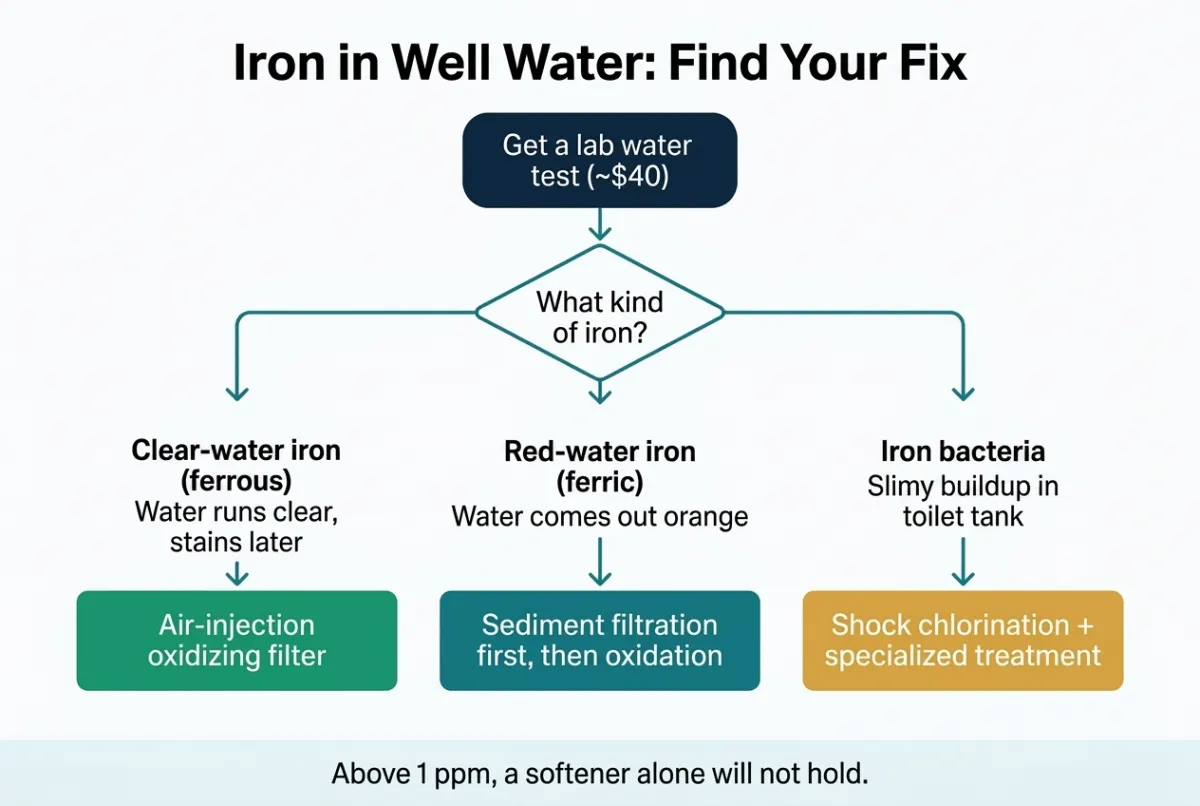
Iron above 0.3 ppm starts staining. Above 1 ppm it ruins appliances. There are three forms — ferrous (dissolved, clear water), ferric (particulate, red water), and iron bacteria (slime in the tank) — and each responds differently to treatment. Air-injection oxidation handles ferrous and ferric iron in a single tank with no chemicals; levels above 7 ppm typically require an oxidizing media like Filox or Birm in addition. See our full breakdown at /problems/iron.
Hydrogen sulfide — rotten-egg smell
H₂S above 0.5 ppm is detectable; above 1 ppm it's the first thing every visitor notices. Air-injection systems oxidize H₂S into elemental sulfur and filter it out. Catalytic carbon can handle lower concentrations on its own. At high levels (above 6–8 ppm) you may need both stages. The SpringWell WS1 is rated to 8 ppm H₂S — one of the higher published ceilings on the market.
Sediment — sand, silt, particulates
Sediment is the easiest villain to handle and the most important to address first. A spin-down prefilter ($30–$80) upstream of any treatment system catches particles before they clog media or membranes. Skipping it shortens the life of every downstream component. If your water is seasonally turbid — common after heavy rain on shallow wells — a 5-micron sediment cartridge adds another layer of insurance.
Hardness — scale on fixtures and appliances
Hardness above 7 gpg (grains per gallon) accelerates scale buildup in water heaters and shortens appliance life. A conventional salt-based softener is still the most effective whole-house solution. Template-assisted crystallization (TAC) systems are a salt-free alternative but do not remove hardness — they alter the crystal structure so scale doesn't deposit as readily. If your iron is also elevated, treat iron first: softeners foul at iron levels above roughly 1 ppm. See /problems/pfas for how hardness interacts with PFAS reduction strategies.
Reading your water test results
State extension lab results come in ppm (parts per million) for dissolved metals and gpg (grains per gallon) for hardness. Here is what the numbers mean for equipment selection:
| Contaminant | Threshold that triggers equipment | What to add |
|---|---|---|
| Iron (total) | Above 0.3 ppm | Air-injection iron filter (stage 2) |
| Hydrogen sulfide | Above 0.5 ppm (detectable smell) | Air-injection filter handles both iron and H₂S in one tank |
| Manganese | Above 0.05 ppm (EPA secondary limit) | Air-injection with media rated for manganese (WS1 handles up to 1 ppm) |
| Hardness | Above 7 gpg | Water softener (downstream of iron filter) |
| pH | Below 6.8 with iron present | pH neutralizer (calcite) upstream of iron filter improves oxidation |
| Coliform / bacteria | Any positive result | UV disinfection or well shock chlorination — contact your county health department |
A positive bacteria result requires immediate action — not a filter selection process. Your county health department or a licensed well contractor is the right first call. Equipment selection follows after the contamination source is identified and addressed.
Top pick for well water
Our well-water verdict
The WS1 handles the two most common well-water complaints — iron staining and sulfur smell — in a single air-injection tank. For full sizing guidance, plumber cost ranges, and the edge cases where it falls short, see our complete SpringWell WS1 review. For the specific iron decision tree including how to tell ferrous from ferric iron and when to test for bacteria, see Iron in Well Water.
Questions owners actually ask
Can you filter out iron from well water?
Yes — the method depends on which form you have. Dissolved (ferrous) iron requires oxidation first; air-injection systems like the SpringWell WS1 convert it to solid particles that a media bed catches. Particulate (ferric) iron can be mechanically filtered with a sediment prefilter. Iron bacteria require shock chlorination before any filter system will hold. A lab panel from your state extension service identifies the form and ppm concentration for $30–$60.
What is the best filter for iron in well water?
For ferrous and ferric iron up to 7 ppm, an air-injection oxidizing filter is the most practical residential solution: one tank, no chemicals, self-backwashing on a timer. The SpringWell WS1 handles up to 7 ppm iron and 8 ppm hydrogen sulfide in a single tank at 12 GPM rated service flow. For concentrations above 7 ppm or confirmed iron bacteria, professional sizing and a two-stage approach are required.
How much is an iron filter for well water?
We do not publish an all-in figure, because the leading air-injection systems do not publish pricing we can read and verify — get the current system price from the manufacturer and a labor quote from a local plumber. What we can tell you is the shape of the cost: the system, a bypass valve, a backwash drain line and a power connection are one-time costs, and after that the operating bill is only electricity for the control valve and the water used during backwash. Media life is typically 10+ years with no consumable cartridges. A softener downstream, if hardness is also elevated, adds roughly $400–$800 in labor on top of the softener itself.
Is it safe to drink well water that has iron in it?
The EPA's secondary maximum contaminant level for iron is 0.3 ppm — an aesthetic guideline, not a health standard. For health guidance on iron in drinking water, visit epa.gov. From a property standpoint: iron above 0.3 ppm stains fixtures and laundry, above 1 ppm damages appliances and softener resin. An iron filter eliminates these downstream effects by capturing iron at the point of entry.