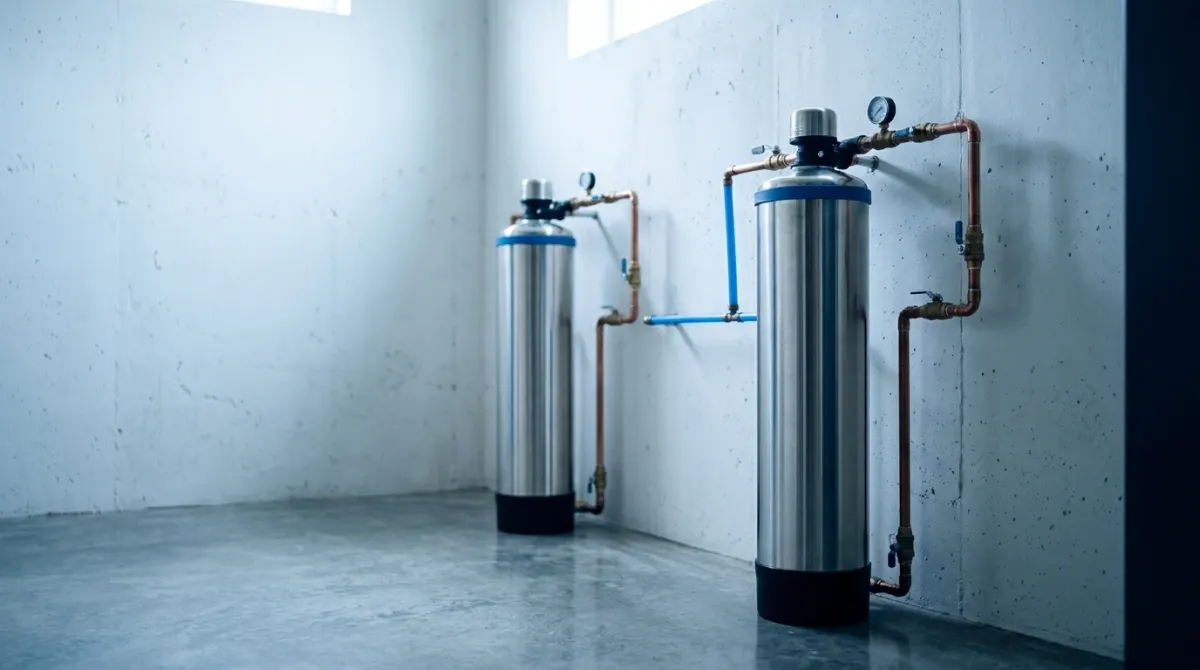
Pillar — Water Treatment
Water softener and whole-house filter guides
Hardness, chlorine, sediment and iron are four different problems with four different fixes. This pillar covers which machine solves which, how to size it, and what it costs to run.
A water softener strips calcium and magnesium out of your supply so scale stops forming. A whole-house filter does the other job: chlorine, sediment, taste and odour. Most homes need both, plumbed in that order.
How softeners actually work: ion exchange in plain terms
Inside the tall tank is a bed of plastic resin beads, each carrying a loose sodium ion. Hard water flows through, and because calcium and magnesium hold a stronger charge than sodium they stick to the resin and kick the sodium loose. That trade is the whole trick — ion exchange, nothing more exotic. Eventually every bead is loaded, so the control valve regenerates: it draws strong brine from the salt tank and the concentration of sodium drives the calcium back off to the drain. Hence the salt supply, the drain line and the running cost. Two things follow: softened water carries slightly more sodium, and resin is not immortal, because chlorine oxidises it and iron fouls it.
Sizing by household and grains per gallon
Sizing is arithmetic, not opinion. Take the number of people in the house, multiply by 75 gallons a day — the long-standing residential planning figure — and multiply by your hardness in grains per gallon. That is your daily grain load, and you want a unit rated to cover three to seven days of it so the valve regenerates on a sane schedule instead of every night. Undersize it and you regenerate constantly, burning salt and wearing the valve. Test your water first; a guessed hardness number is worse than useless.
| Household | Hardness | Daily grain load | Typical rated capacity |
|---|---|---|---|
| 1–2 people | 5–10 gpg | 750–1,500 grains/day | 24,000 grain |
| 3–4 people | 5–10 gpg | 1,500–3,000 grains/day | 32,000 grain |
| 3–4 people | 11–20 gpg | 3,300–6,000 grains/day | 40,000–48,000 grain |
| 5–6 people | 21+ gpg | 7,875+ grains/day | 64,000 grain or twin tank |
Arithmetic from 75 gallons per person per day, not measured field data. Add roughly 5 grains per gallon of load for every 1 ppm of dissolved iron. Sizing by model is in the softener buying guide.
Free to use — please credit
Water Hardness Scale: GPG and mg/L Classifications
Where to go next
+ Embed this graphic on your site− Hide embed code
Copy the snippet below. You are welcome to use this graphic anywhere, including commercially, as long as the credit link stays intact.
Saltless water softener: what it does and what it does not
A saltless water softener is a conditioner, and the naming causes most of the disappointment. The common design is template-assisted crystallisation: water passes over a media bed whose surface encourages dissolved hardness to form tiny stable crystals that stay suspended rather than plating onto pipe and heating elements. No salt, no brine, no drain line. What it does not do is remove anything — test the outlet and you get the number you put in, because the minerals are still there in a form less inclined to cement itself to your water heater. Judge it on the right goal: less scale with almost no upkeep, yes; the slick feel of soft water, no.
Salt free water softener versus salt-based: how to actually decide
Four questions settle it. What is your hardness? Below roughly 10 grains per gallon a conditioner has an easy job; past 15 the evidence it fully protects appliances gets thin, and a salt free water softener starts to look like false economy. Is there a drain within reach? No drain means no regeneration. Is anyone watching sodium intake? Potassium chloride solves that at a higher running cost. And what actually annoys you — scale on fixtures, or the feel of the water? The cheaper unit that solves the wrong problem is the expensive one.
Whole house water filter: the other half of the job
A whole house water filter treats what a softener ignores. Sediment cartridges catch sand, silt and rust flakes. Carbon — granular, block, or catalytic where the utility uses chloramine — takes out chlorine taste and musty odours. Neither touches hardness. Sequence matters: sediment first, carbon next so chlorine stops oxidising the resin, softener after that, and UV last, because a lamp only disinfects water that is already clear.
| Equipment | What it handles | What it leaves behind | Upkeep |
|---|---|---|---|
| Salt-based softener | Calcium, magnesium, some dissolved iron | Chlorine taste, sediment, bacteria | Salt top-ups, brine tank clean-out |
| Salt-free conditioner | Nothing — it alters how hardness crystallises | Hardness itself, chlorine, sediment, bacteria | Media cartridge on schedule |
| Whole-house carbon filter | Chlorine, chloramine, taste and odour | Hardness, bacteria, dissolved metals | Media or cartridge changes |
| Sediment pre-filter | Sand, silt, rust flakes | Everything dissolved | Cartridge swaps, the most frequent item |
| UV disinfection | Inactivates bacteria and microbes | Hardness, metals, taste | Annual lamp change |
Read from manufacturer specifications and the relevant NSF/ANSI standards — this site does not test hardware. Certifications to look for: NSF/ANSI 44 for cation-exchange softeners, 42 for aesthetic claims, 53 for health claims, 55 for UV, 58 for reverse osmosis.
Water softener maintenance: the short list that matters
Water softener maintenance is mostly one habit: look in the brine tank once a month, checking for two failures. A salt bridge is a hard crust over an empty cavity, so the unit draws brine from a tank that looks full and regenerates with plain water — the classic “it stopped working and I only just filled it” call. Break the crust and stop overfilling; two-thirds is plenty. The second is mushing, where fine salt compacts into sludge and blocks the draw. Cleaner grades make both less likely. Beyond that, run a resin bed cleaner once or twice a year on iron-bearing water. More on water softener salt.
Best Water Softener
Salt-based vs. salt-free, sized by household and hardness
Read guide →Best Whole-House Water Filter
Carbon and sediment filtration for chlorine taste, odor and particulates.
Read guide →Best UV Water Purifier
UV disinfection — what it treats, and where it fits in the train.
Read guide →Well Water Guide
Sediment, iron and sulfur come before a softener on a well.
Read guide →Water Softener for Well Water
Why iron, not hardness, decides which softener a well needs.
Read guide →Softener Sizing Calculator
Three numbers from your water test give you the grain capacity.
Read guide →Culligan Water Softener Prices
Why the biggest brand publishes no price, and what to ask instead.
Read guide →Fleck Water Softener Review
Fleck makes the valve, not the softener — and that saves you money.
Read guide →Common questions
What does a water softener actually remove?
Calcium and magnesium, the two minerals that make water hard, plus a modest amount of dissolved iron. It swaps them for sodium or potassium ions on a resin bed. It does not remove chlorine, sediment or bacteria — those need filtration or disinfection.
How do I know what size softener I need?
Multiply the people in the house by 75 gallons a day, then by your hardness in grains per gallon. That is your daily grain load. Pick a unit whose rated capacity covers three to seven days of it. Test your hardness first — guessing is how people end up with the wrong tank.
Is a saltless water softener a real softener?
Not in the strict sense. Salt-free conditioners change how hardness minerals behave so they are less likely to bond to pipe and heating elements, but the minerals stay in the water and hardness at the tap does not drop. Fine for scale control; not a substitute if you want the feel of soft water.
Do I need a whole house water filter as well as a softener?
Often yes, because they solve different complaints. If your water tastes of chlorine or smells musty, a softener will not touch it. Homes with both run sediment first, carbon next, then the softener, so grit and chlorine never reach the resin.
How much maintenance does a softener really need?
Very little, if you keep two habits: check the brine tank monthly and break up any salt bridge, and keep it no more than two-thirds full so the salt cannot compact. A resin bed cleaner once or twice a year on iron-bearing water covers the rest.
Which certifications are worth looking for?
For a cation-exchange softener, NSF/ANSI 44. For filters: 42 for aesthetic claims like chlorine taste, 53 for health-related claims, 401 for emerging contaminants, 55 for UV, 58 for reverse osmosis. A claim tied to a standard number is verifiable; a claim of "99% removal" with no standard behind it is not.
What does all of this cost installed?
Typical installed ranges, not measured invoices, are broken out line by line on the cost hub — unit, labour, fittings and the annual salt bill. The biggest swing factor is whether the house already has a plumbing loop near the main.
Related pillars
On a private well and dealing with pump or pressure problems too? See Well & Pumps. Water backing up in the basement? Sump & Basement, or straight to sump pump repair. Diagnose before you buy with the Fix My Water symptom index, hard water symptoms, iron staining or PFAS in drinking water. Want real installed prices before you shop? What It Really Costs. Our sourcing rules are on how we evaluate.