Verdict: BUY · Score 92/100
SpringWell CF1 review:
specs, flow rate and installed cost
The CF1 is the rare system where the marketing checks out against the published numbers: a million-gallon catalytic carbon bed, honest flow ratings, and a tank design that doesn't ask for new media every two years. Here's the full math — including the two things we'd change.
By Tim Parker — Reads the spec sheets and prices the full install
What it is
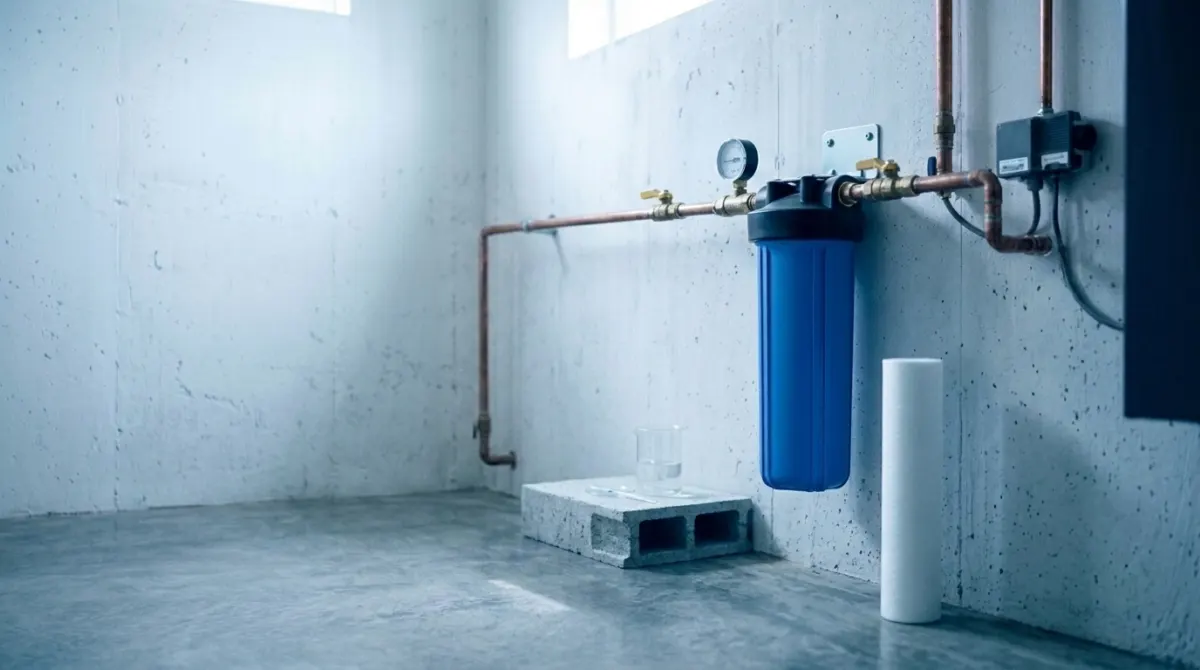
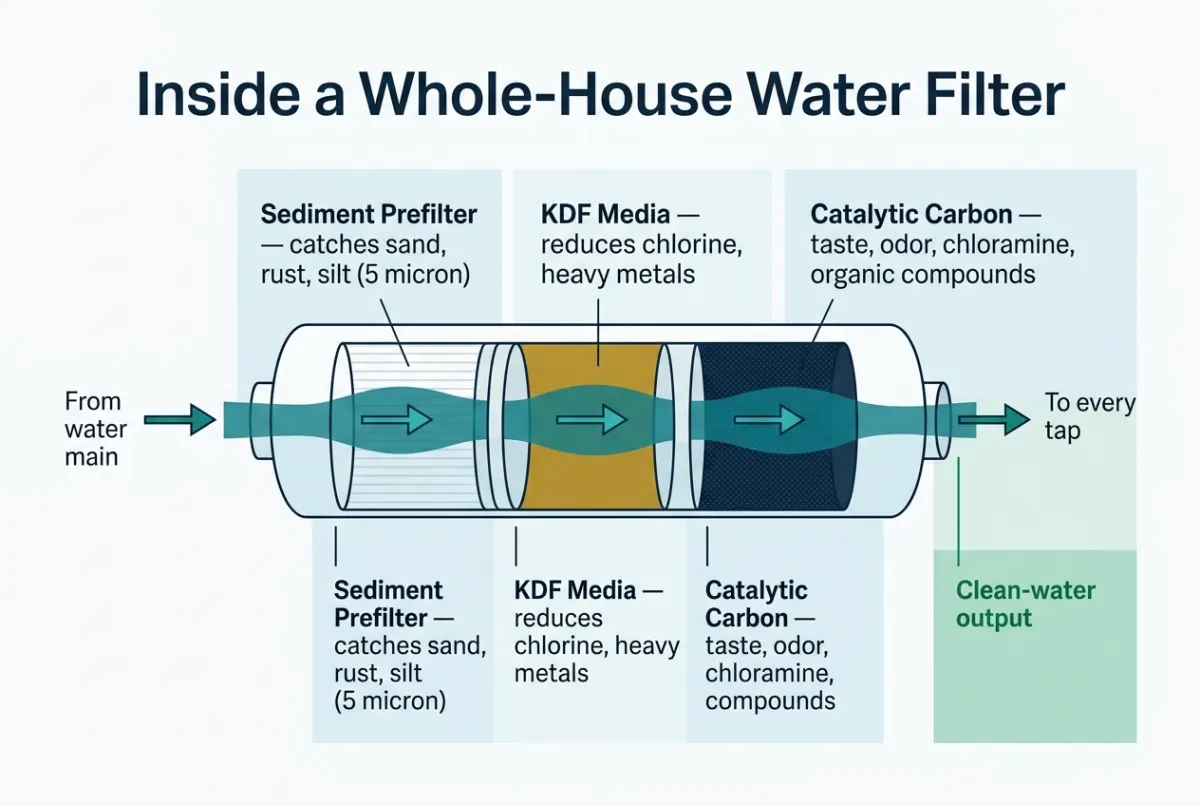
A whole-house point-of-entry filter for city water: catalytic coconut-shell carbon plus KDF media in SpringWell's four-stage ActivFlo tank, with a 5-micron sediment prefilter ahead of it. It targets chlorine, chloramine, taste and odor — the things municipal water actually brings into your house. It is not an iron or sulfur system; that's the WS1's job.
We earn nothing if you buy through this link — the manufacturer sells it directly and we are not in their programme.
The numbers that decide it
| Checkpoint | CF1 (1–3 bath size) | Our read |
|---|---|---|
| Media life | 1,000,000 gallons rated | ≈10 yrs for a family of four — best-in-class |
| Service flow | 9 GPM | Two showers + a laundry load, no pressure sag |
| Maintenance | Sediment prefilter every 6–9 mo (~$25–40/yr) | Only recurring cost — trivially cheap |
| Typical street price | $1,170 | Watch for frequent sitewide sales |
| Pro install | $400–$600 typical plumber quote | Handy owners with PEX experience can DIY |
| Certification scope | Components certified; system performance not NSF-listed | The honest knock — see below |
Install: what the official video doesn't tell you
The CF1 ships with clear mounting instructions, but three things catch DIYers off-guard that SpringWell's documentation skims.
Shutoff valve location. The system must go on the main line after the meter shutoff but before any branch to the water heater. Installing it downstream of the heater defeats the whole-house purpose and can void the warranty. If your main shutoff is corroded or a gate valve (common in homes built before 1990), budget $80–$150 to have a plumber swap it for a ball valve at the same appointment — you will need a reliable shutoff for every future prefilter change.
Bypass loop.SpringWell includes a bypass valve assembly. Install it — don't skip it to save an hour. You will change that sediment prefilter twice a year for the next decade, and doing it without a bypass means shutting off the whole house each time. A properly plumbed bypass takes the job from a 15-minute inconvenience to a 2-minute cartridge swap.
Drain proximity.The CF1 itself doesn't backwash, but the sediment prefilter housing needs to drain to a nearby floor drain or utility sink when you swap cartridges. Plan the installation location with that in mind — a garage corner with no drain nearby means carrying a dripping housing to the utility room twice a year, which most owners stop doing after the first time.
What we'd change
First, certification.Like most direct-to-consumer brands, SpringWell certifies materials and components rather than paying for full NSF/ANSI 42 system-performance listing. The media and tank design are industry-standard and the capacity math is plausible — but a published third-party performance test would end the argument, and we'd like to see it. Second, the prefilter housingis the part you'll touch twice a year; buy a spare O-ring kit with the system and thank us in February.
CF1 vs the field
The CF1's closest competitor in the direct-to-consumer space is the Aquasana Rhino EQ-1000. Both claim a million-gallon media bed; the meaningful difference is service flow — 9 GPM for the CF1 against the Rhino's ~7 GPM published ceiling. For families in 3-bathroom homes that number shows up at 7 a.m. when the dishwasher, two showers, and a laundry load overlap. The full side-by-side is in our SpringWell vs Aquasana comparison.
Who shouldn't buy it
Well water households.The CF1 is engineered for city water chemistry — specifically chlorine, chloramine, and disinfection byproducts. If your water comes from a well and carries iron above 0.3 ppm, the CF1's carbon bed will foul with iron deposits long before the million-gallon mark. Fix iron first with the WS1, then run a carbon stage downstream if you want additional polishing.
PFAS-focused buyers. Catalytic carbon reduces PFAS in laboratory conditions, but the CF1 does not carry a formal NSF P473 certification at whole-house flow rates. If PFAS is a documented concern in your supply, the correct protocol is the CF1 (or equivalent) for whole-house reduction plus a certified under-sink reverse osmosis system at the kitchen tap. The full reasoning is on our PFAS guide.
Anyone expecting bacteria removal. Carbon and KDF media are not rated for pathogen removal. If your water test shows E. coli or coliform, a UV disinfection system is the right tool — not a carbon filter.
Ten-year cost of ownership
System ($1,170) + install ($0–$600) + a decade of prefilters (~$300) = $1,470–$2,070 over ten years, or roughly $12–17 a monthfor filtered water at every tap in the house. The cartridge-based systems it competes with cost less on day one and more every year after — that's the whole trick of the million-gallon bed.
Verdict — 92/100
BUY for city water. The specs are published, the math holds, and the maintenance is a twice-a-year cartridge.
On well water, fix iron and sulfur first with the WS1 — carbon beds foul fast downstream of untreated iron. Comparing against the famous one? CF1 vs Aquasana Rhino, settled with a spec sheet.
Questions owners actually ask
What is the top rated whole house water filter system?
For city water, the SpringWell CF1 consistently earns top marks on the specs that matter: 9 GPM service flow, a 1,000,000-gallon catalytic carbon media bed, and a single sediment prefilter as the only recurring maintenance. Its published capacity math holds up against competitor claims, and the ten-year cost of ownership — roughly $12–17 per month all-in — undercuts cartridge-based alternatives that look cheaper on day one.
What are the disadvantages of a whole house water filter?
The two main disadvantages are upfront cost (a quality whole-house system plus professional installation runs $1,170–$1,900 for the CF1) and the need for a dedicated installation space near the main water line with access to a drain for future maintenance. An undersized system can reduce household water pressure, so correct GPM sizing relative to bathroom count is critical. The CF1 also lacks a full NSF system-performance listing — components are certified, but the whole system is not third-party tested at the performance level.
What is the best water filter for E coli?
Carbon filters — including the CF1 — are not rated for bacterial removal. E. coli and other pathogens require UV disinfection or reverse osmosis with an antimicrobial stage. If your water test shows coliform bacteria, a UV system installed ahead of the carbon filter is the correct protocol. See your state extension lab or EPA's drinking water guidance for certified testing and treatment options.
What is the best whole home water filter consumer report?
Independent evaluations of whole-house filters focus on three published numbers: service flow (GPM at rated pressure), media life (total gallons before replacement), and certification scope (NSF/ANSI standard and which specific contaminants are covered). The CF1 rates 9 GPM service flow and 1,000,000-gallon media life in its 1–3 bath configuration, with component-level certifications. Compare any competitor's claims on those same three axes — not marketing language — before deciding.
We earn nothing if you buy through this link — the manufacturer sells it directly and we are not in their programme.