Pillar — Sump & Basement
Sump pump installation, repair & backup guides
A pit in the floor, a pump in the pit, a float that starts it and a pipe that carries the water away. The system is only as good as its weakest part on the night it matters.
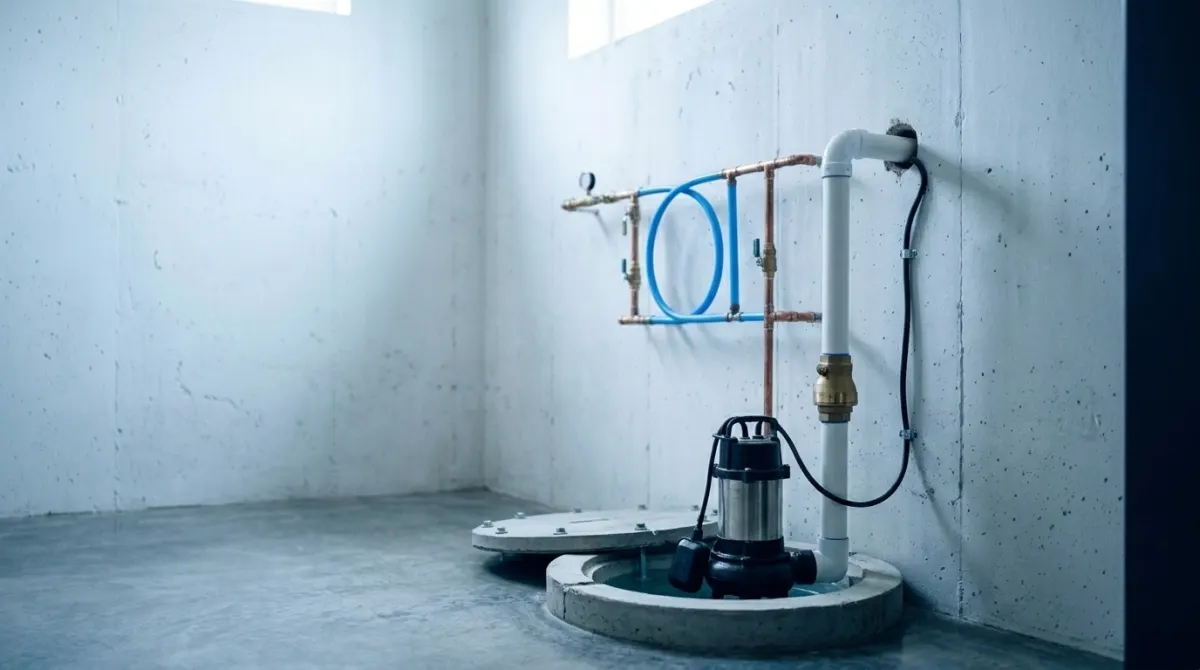
A sump pump sits in a pit below the basement floor, collects groundwater that drain tile feeds into it, and pushes it outside once the water hits a set level. Power loss is its single biggest failure mode.
Start here
Buying or replacing one? The full buyer's guide covers submersible versus pedestal, sizing on head height rather than horsepower, which switch type fails which way, cast iron versus thermoplastic, and when a backup is genuinely required.
What is a sump pump, and what it does not do
Sump just means a low point where water gathers. Cut that point into the lowest floor of a house, ring the footing with perforated drain tile feeding it, and you have a deliberate place for groundwater to arrive rather than an accidental one. When the pit rises far enough to lift a float, the motor starts and pushes the water up a discharge pipe beyond the foundation. That is the whole idea: intercept water while it is still under the slab. This is hydrostatic pressure management, so it will not stop surface water pouring over a threshold, and it does not treat water quality at all.
The five parts, and how each one fails
Almost every basement water call traces to a short list of components, and knowing which part does what turns a mystery into a five-minute check: watch one cycle from float rise to shut-off and see which stage misbehaves.
| Part | Its job | How it usually fails |
|---|---|---|
| Basin (crock) | Collects drain-tile groundwater and holds the pump | Too small, so it cycles constantly; no lid, so debris falls in |
| Pump | Lifts water up the discharge line and outside | Worn impeller, seized motor, or undersized for the lift |
| Float switch | Senses level, starts and stops the motor | Snags on wall, cord or pipe and never trips |
| Check valve | Stops discharge water falling back into the basin | Held open by grit, so the same column is re-pumped |
| Backup system | Runs the basin when power or the primary is gone | Battery quietly dead because nobody tested it |
Read from manufacturer documentation and standard installation practice; this site does not run hardware to destruction. Step-by-step diagnosis lives on sump pump repair.
The sump pump basin does more work than you think
The basin sets the terms for everything above it. Its diameter decides whether a submersible physically fits and whether a tethered float can swing without catching the wall. Its volume decides how long the motor runs per cycle — too small a crock means dozens of short starts an hour in wet weather, and starts are what wear a pump out. Two details get skipped: a sealed lid cuts noise and on a radon-mitigated house forms part of the mitigation path; and the pump should sit on solid support, not loose gravel, because silt kills impellers.
Installation: what a correct job includes
Where a basin already exists, the job is about details: sized to vertical lift plus pipe friction rather than the biggest number on the box, float set so it switches off before the intake is exposed, a check valve in the discharge, a sealed lid, and — the one that gets cut — a dedicated grounded circuit with GFCI where code requires it. A first-time job is bigger: cutting the slab, setting the crock, connecting drain tile and finding a legal discharge point far enough out that water does not loop straight back.
Where to go from here
The rest of this cluster answers one decision each. Sizing, model shortlists and switch selection all live on the buyer's guide rather than here, so there is one place to read them and one set of numbers to trust.
Sump pump buyer's guide
Sizing on total head, submersible versus pedestal, switch types and how each one fails, cast iron versus thermoplastic, and the units worth shortlisting.
Installation
Cutting the slab and setting a new crock, tying in drain tile, discharge routing, check valve placement and the electrical work a correct job includes.
Repair and diagnosis
Motor runs but no water leaves, pump short-cycles, float hangs up, alarm sounding — a symptom-by-symptom walkthrough of what to check and in what order.
Battery backup
What a DC backup covers, how water-powered and generator options compare, and why the at-lift gallons figure beats any runtime claim.
What it costs
The drivers behind the installed number: horsepower, pump style, whether a backup is included, and whether a basin has to be cut into an existing slab.
Free to use — please credit
Why your sump pump's advertised GPH is a lie
Where to go next
+ Embed this graphic on your site− Hide embed code
Copy the snippet below. You are welcome to use this graphic anywhere, including commercially, as long as the credit link stays intact.
Common questions
What is a sump pump and what does it do?
It sits in a pit below the basement floor, collects the groundwater that drain tile routes into that pit, and pushes it outside once the water reaches a set level. It manages water pressing under the foundation, not surface flooding through a door or window well.
Do I actually need one for my basement?
You need one if the basement sits at or below the water table for part of the year, if the house was built with drain tile and a pit, or if water has risen through the slab or the wall-floor joint after heavy rain. Houses on high, well-drained ground often have a pit and no pump.
How often should I test it, and how?
Twice a year at minimum, and again before a wet season. Pour enough clean water into the basin to lift the float and confirm it starts, moves water and shuts off cleanly. Then unplug the primary and repeat so the backup takes the call. An untested backup is not a backup.
The pump runs but no water leaves. What is wrong?
Usually the discharge path: a frozen or blocked outlet, a check valve stuck shut, or an airlock all let the motor run against a closed line. Sometimes it is the reverse — a check valve stuck open lets the column fall back, so the same water gets re-pumped forever.
Which guide should I start with?
If you are shopping or replacing, start with the buyer's guide — that is where sizing, switch types and the shortlist live. If the pump is already in and misbehaving, go to repair. If there is no pit yet, installation. Backup and cost are the two follow-on decisions.
Related pillars
On a private well with a pump or pressure problem? Well & Pumps. Softening or filtering your water? Water Treatment. Want real installed prices before you shop? What It Really Costs. Cloudy or gritty water alongside basement damp is a separate problem — check the Fix My Water symptom index, the well water guide or water softener salt.
If you just need the answer: the primary pump this whole section keeps coming back to is the cast-iron workhorse below.