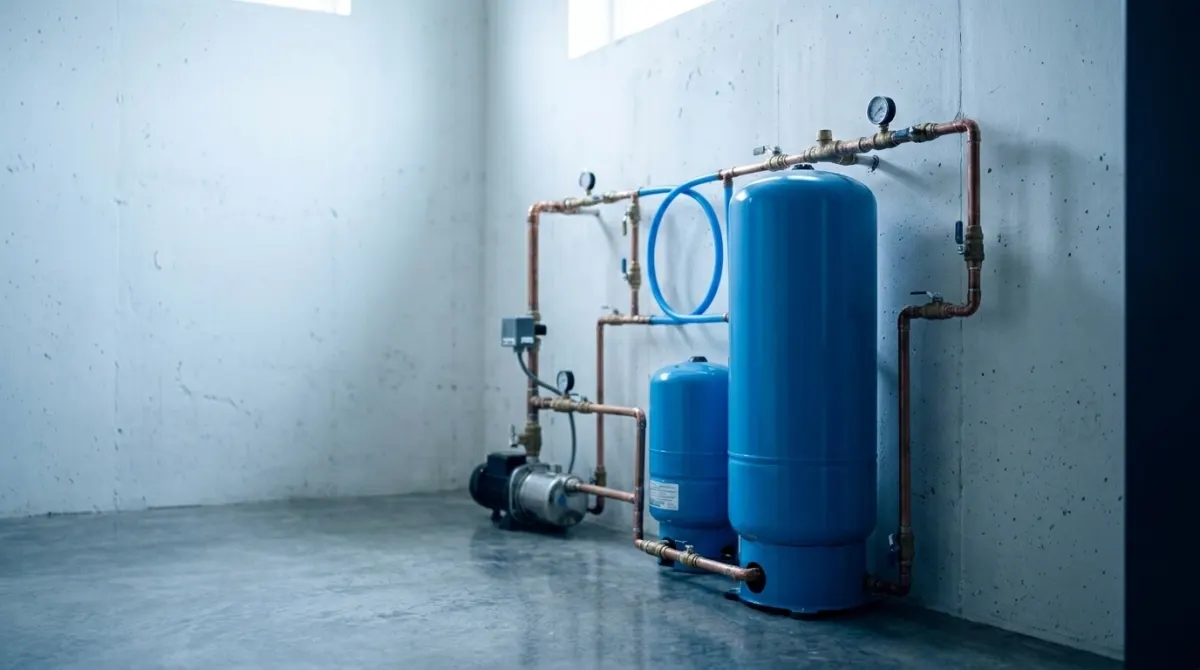
Pillar — Well & Pumps
Well pump, pressure tank & switch guides
Three parts run a private water supply: the pump in the ground, the tank that stores pressure, and the switch that starts it. Diagnose them in the right order and you rarely pay for the expensive one.
A well pump lifts water from the casing and pushes it into a pressure tank; a switch starts and stops it. Wells under about 25 feet to water use a jet pump, deeper wells use a submersible.
Which well pump you actually need: check the breaker first
Before you order anything, go look at the breaker feeding the well. A 230V circuit is two breakers ganged together (or one wide double-pole breaker); 115V is a single narrow one. Buy the wrong voltage and the pump does not run at all — it is not a "runs a little weak" mistake, it is a return. Most residential wells run 230V, but plenty of shallow or older setups are wired 115V, so verify it rather than assume it.
What lives in a well system
A private supply has three interdependent parts. The pump moves water. The pressure tank holds a cushion of water under compressed air so opening a tap does not fire the motor every time. The switch reads pressure and closes the circuit at cut-in, opening it at cut-out. Because the three sit in series, a fault in one shows up as a symptom that looks like a fault in another — which is why so many homeowners buy a pump when the tank was at fault.
Submersible well pump: the sealed motor at the bottom
This is a long thin cylinder — motor below, stacked impeller stages above — hanging in the water on the drop pipe. Because it pushes rather than sucks, depth is not the barrier it is for a jet unit; you add stages for more head. Being submerged keeps it cool and almost silent, so the first sign of trouble is a pressure symptom, not a noise. The trade-off is access: servicing one starts with pulling it.
| Pump type | Workable depth to water | Where it sits | What decides it |
|---|---|---|---|
| Shallow well jet pump | To about 25 ft | Above ground, basement or well house | Limited by suction lift, not motor size |
| Convertible / deep well jet pump | Roughly 25–110 ft | Above ground, ejector down the well | Two pipes down the casing; less efficient |
| Submersible well pump | 25 ft to several hundred | In the water at the bottom of the casing | Pushes rather than sucks; depth is no hard limit |
| Constant-pressure (variable speed) | Follows the pump | Controller at the tank | Smaller tank, but electronics that can fail |
Depth bands reflect standard suction-lift physics and published pump-curve conventions, not measurements taken by this site. Your own static water level and required pressure set the real answer.
Shallow well pump: why 25 feet is the wall
A shallow well jet pump sits above ground, pulling water up a single pipe. It does not really pull: it lowers pressure at its inlet and lets the atmosphere push the column up. At sea level that ceiling is near 33 feet, and after friction and cavitation margin the limit lands around 25 feet to the water surface — not to the bottom of the well, which is the distinction people get wrong. Horsepower changes nothing. The upside: it sits in your basement where you can service it without a rig.
Deep well pump options past that limit
Past 25 feet you have two routes. A convertible jet setup keeps the motor above ground and drops an ejector into the casing on two pipes: one drives water down through a nozzle, the other carries the combined flow back up. It reaches roughly 110 feet, but moves less water per watt. The other is the submersible, which most modern deep installations use because pushing beats pulling. Choose on two numbers: static water level, and the gallons per minute the house needs at your pressure.
Well pressure tank: the part that saves the pump
A well pressure tank is a steel vessel split by a rubber bladder, water one side, compressed air the other. The air is a spring: the pump compresses it on the way to cut-out and it pushes water back to the house afterwards. That draw-down volume is the only reason the motor is not starting every time somebody washes their hands, and starts kill pumps. Set the pre-charge about 2 psi below cut-in, system drained. When the bladder splits the tank fills, the spring disappears and short cycling begins. Press the schrader valve on the crown — water instead of air means the bladder is gone.
Pressure switch for well pump: cheap part, big consequences
The pressure switch for a well pump is a small box on the tank tee holding a diaphragm, a spring and a set of contacts. It is the cheapest component in the system and the cause of a large share of no-water calls, because those contacts arc every cycle and eventually pit, weld or refuse to close. Most systems run 30/50, 40/60 or 50/70 psi, and it must match both the pump curve and the tank rating. The little nipple feeding it clogs with iron and scale too, which makes a good switch behave like a broken one. Cost drivers are on what it really costs.
Diagnosing short cycling and the rest of the usual suspects
Work the ladder cheapest and most likely first. Short cycling has a near-standard answer — the tank — and chasing it up the pump end wastes money on a machine that was fine. Kill power at the breaker first.
| Symptom | First suspect | How to check it |
|---|---|---|
| Rapid short cycling, pump clicks on and off | Waterlogged pressure tank — bladder failed | Tap it: uniformly solid means full of water. Check air charge, system drained. |
| Pressure swings wildly at the tap | Pressure switch contacts or wrong cut-in setting | Watch the gauge through a full cycle against the switch rating. |
| Pump runs constantly, never shuts off | Leak, dropped water level, worn pump end | If it still runs with every fixture closed, the loss is upstream. |
| No water at all, breaker holding | Switch, capacitor or control box, not the pump | Verify voltage at the switch and control box first. |
A diagnostic order, not a guarantee — several faults produce the same symptom, and a licensed well contractor is the right call before anything is pulled from the casing.
Well pump replacement: what changes the job
Replacement is two very different jobs. Swapping a jet unit in a basement is bolt-up work: isolate, drain, unbolt, fit, prime, set the switch. Replacing a submersible means pulling hundreds of feet of drop pipe and wire, keeping every foot off the dirt so the well is not contaminated, then setting the new one above the screen and below the drawdown level. That is rig work, regulated in most states. While it is out, replace the drop pipe, check valve, torque arrestor and splice kit.
Common questions
What does a well pump actually do?
It lifts water out of the casing and pushes it into the house at usable pressure. It does not run continuously: it fills a pressure tank, a switch shuts it off at cut-out, and the tank feeds the house until cut-in.
Why is 25 feet the limit for a jet pump?
A suction pump does not pull water up; atmospheric pressure pushes it. At sea level that caps out near 33 feet in theory, and friction and cavitation bring the practical limit to roughly 25. Extra horsepower changes nothing.
What causes short cycling?
Usually a waterlogged pressure tank whose bladder has failed, leaving nothing to cushion the system, so cut-out and cut-in arrive almost instantly. Pitted switch contacts do the same. It destroys pumps by forcing hundreds of starts a day.
What pressure should the switch be set to?
Most residential systems run a standard pair — 30/50, 40/60 or 50/70 psi. The tank air pre-charge sits about 2 psi below cut-in with the system drained. Raising cut-out past what the curve and tank are rated for buys an early failure, not better showers.
Should I replace the pump myself?
A jet pump in a basement is within reach of a competent DIYer. A submersible is not: pulling hundreds of feet of drop pipe, keeping it out of the dirt, and setting depth correctly is rig work, regulated in most states.
What does well pump replacement cost?
No measured installed figure is published here, so none is quoted. Depth drives it above all, because a deep submersible must be pulled before the new one goes in, and that labour scales with every foot of drop pipe.
Related pillars
Softening or filtering city or well water? Water Treatment. Water backing up in a basement or crawlspace? Sump & Basement, or straight to sump pump repair. Want real installed prices before you shop? What It Really Costs. Water quality on a well is a separate system: start with the well water guide for treatment order, or go straight to iron and sulfur staining, hard water, the softener buying guide or water softener salt.