Buyer's guide · well pressure tank sizing
Amtrol WX-202 review:
the tank that stops your pump short-cycling itself to death
A pressure tank is the least glamorous part of a well system and the part most likely to be sized wrong. Amtrol's WX-202 is a 20-gallon diaphragm tank — but the number that actually matters isn't the 20 gallons, it's the much smaller drawdown, and whether the precharge is set correctly for your pressure switch. Here's the honest read of both.
By Tim Parker — Reads the spec sheets and prices the full install
What it is
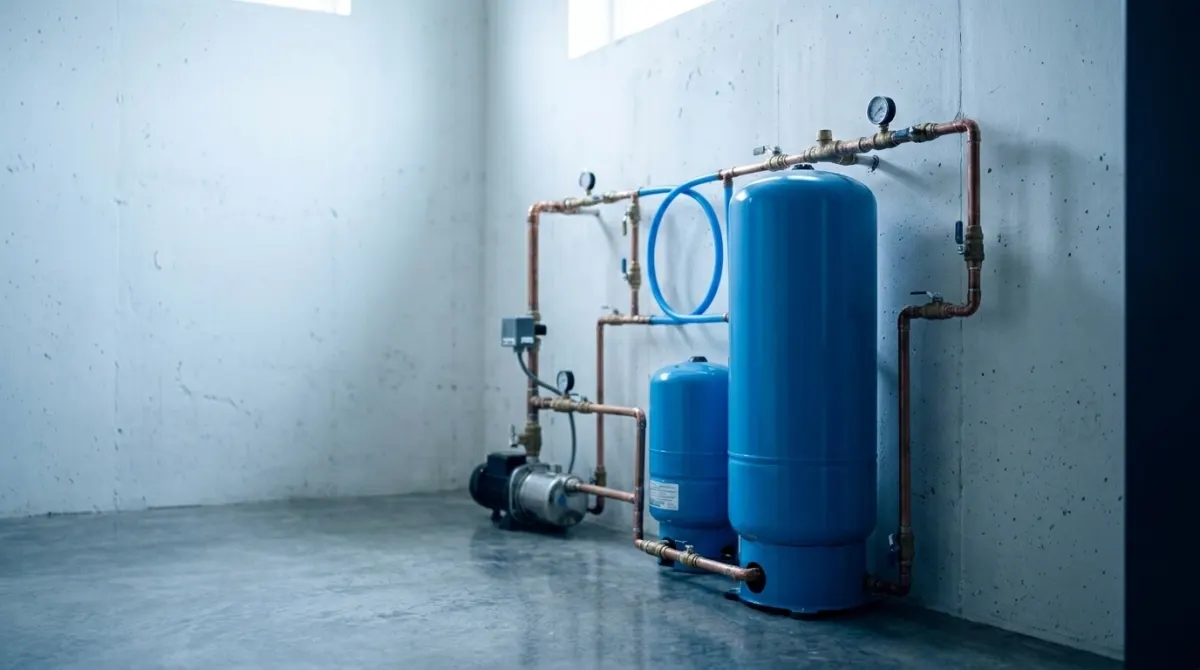
The WX-202 is Amtrol's 20-gallon pre-pressurized diaphragm well tank — a sealed steel shell with a butyl rubber diaphragm separating an air charge from the system water. It sits between the pump and your household plumbing, storing a reserve of pressurized water so the pump doesn't start and stop on every small draw. It is not the pump and it does not do anything on its own — its entire job is absorbing the mismatch between pump output and instantaneous household demand, and how well it does that job depends far more on correct sizing and precharge than on brand.
The numbers Amtrol publishes
| Checkpoint | WX-202 (per Amtrol) | Our read |
|---|---|---|
| Tank volume | 20.0 gallons | Total capacity — NOT the usable drawdown, see below |
| Max acceptance factor | 0.57 | Amtrol's own metric for usable capacity vs total volume |
| Dimensions | 15.5" diameter × 32" height | Confirm mechanical room clearance before ordering |
| System connection | 1" stainless steel FNPT | Corrosion-resistant where the tank meets your plumbing |
| Diaphragm | Heavy-duty seamless butyl | The wear part — seamless construction avoids a seam-failure point |
| Factory precharge | 38 PSIG | A default — re-set to ~2 PSI below your switch's cut-in, see below |
| Max working pressure | 150 PSIG | Well above typical residential switch settings |
| Liner | Antimicrobial polypropylene | Corrosion-resistant, NSF-listed water contact |
| Warranty | 7 years | Long for a tank in this category |
Specifications above are Amtrol's own published figures at amtrol.com, cross-checked against Amtrol's WX-100/200/300 series submittal data book. Amtrol expresses usable capacity through a Maximum Acceptance Factor rather than a single drawdown-in-gallons number broken out by pressure switch setting; the approximate 5-6 gallon drawdown figures commonly quoted at 30/50 and 40/60 PSI settings come from distributor cut sheets republishing Amtrol's data, not from an amtrol.com page stating that number directly — we flag that distinction rather than presenting it as a first-party Amtrol figure.
Drawdown vs. total volume — the number that actually matters
This is the single most misread spec on any pressure tank, and the task brief for this page called it out specifically because it's worth getting exactly right: 20 gallons of tank volume is not 20 gallons of usable water.Inside the WX-202, an air charge behind the diaphragm occupies most of that volume, compressing further as water enters and expanding as water is drawn out. Only the water that moves in and out between your pressure switch's cut-in and cut-out points is actually usable — that's the drawdown, and on a 20-gallon tank like this one it commonly runs in the range of 5 to 6 gallons depending on your switch settings, roughly a quarter of the total tank volume. Size a system around the 20-gallon headline number and you will badly overestimate how much reserve the tank is actually giving the pump between starts.
Precharge vs. cut-in: the setting most installs get wrong
Amtrol ships the WX-202 factory precharged to 38 PSIG — but that number assumes a specific pressure switch setting, and it is very often not the setting on your system. The rule that actually governs correct precharge: set the tank's air precharge to roughly 2 PSI below your pressure switch's cut-in pressure, measured on the tank's air valve with a standard tire-style gauge while the system is fully depressurized (no water in the tank). A common residential switch setting is 30/50 PSI — cut-in at 30, cut-out at 50 — which calls for a precharge closer to 28 PSIG, not the factory 38 PSIG default. Leave the factory precharge in place against a mismatched switch setting and the tank's usable drawdown shrinks further than the acceptance-factor math already predicts, which shows up as a pump that seems to start far more often than it should even though the tank itself is not defective.
This is the mechanical reason a pressure tank exists at all: without a correctly precharged tank buffering demand, the pump would start and stop on every faucet opening, since there is no reserve to draw from in between. Frequent starts are hard on a submersible motor — most are only rated for a limited number of starts per hour, and a tank that is undersized, under-precharged, or simply the wrong match for the pump's flow rate is the most common cause of a well pump failing years before it should.
Sizing up or down from the WX-202
| Model | Tank volume (per Amtrol) | Fits |
|---|---|---|
| WX-201 | 14.0 gallons | Smaller household, space-constrained mechanical room, lower-flow pump |
| WX-202 | 20.0 gallons | The common mid-size residential pick |
| WX-202XL | 26.0 gallons | Larger household, higher-GPM pump, or fewer pump starts per day preferred |
The scaling logic is simple even though the underlying acceptance-factor math is not: a higher-output pump — like the Hallmark MA0414X-7A at up to 33 GPM — moves more water per cycle and benefits from the larger drawdown a WX-202XL provides, reducing how often it starts. A pump matched to lower demand, such as either Red Lion RL12G05 pump at 12 GPM, is more comfortably served by the WX-201 or the WX-202 itself. Undersizing the tank relative to the pump is the more common and more damaging mistake of the two — it drives exactly the short-cycling this whole page is about.
Honest limitations
The precharge is not "set and forget." A tank that loses air charge over time — through a slow diaphragm leak or a worn air valve — will under-perform even though it is the correct size, and that failure mode is invisible without periodically checking the precharge pressure with a gauge.
Amtrol does not publish a simple per-switch-setting drawdown table on its own site.As noted above, getting a precise drawdown figure for your exact switch settings means working from the Maximum Acceptance Factor or consulting a distributor cut sheet — not a single number on Amtrol's product page.
The call
The WX-202 is a solid mid-size pick — but the 20-gallon headline number is not what protects your pump. Match the tank size to your pump's actual flow rate, and set the precharge to roughly 2 PSI below your pressure switch's cut-in before the pump ever runs.
Sizing a pump to go with it? Red Lion RL12G05 (230V) or the higher-output Hallmark MA0414X-7A. Need the whole picture on pumps and tanks? Well pumps and pressure tanks.
Questions buyers actually ask
What's the difference between the WX-202's tank volume and its drawdown?
Tank volume — 20 gallons for the WX-202, per Amtrol — is the total internal capacity of the tank shell. Drawdown is the much smaller amount of usable water the tank actually delivers between the pressure switch's cut-in and cut-out settings, since most of that 20 gallons is occupied by compressed air pushing against the diaphragm, not water available to your fixtures. Amtrol's own submittal literature expresses this as a Maximum Acceptance Factor (0.57 for the WX-202) rather than a single drawdown-in-gallons figure; distributor cut sheets that republish Amtrol's data commonly list drawdown around 5-6 gallons at typical 30/50 or 40/60 PSI switch settings. Confusing the 20-gallon tank volume with the actual usable drawdown is one of the most common sizing mistakes on this class of tank.
What precharge pressure should the WX-202 be set to?
Amtrol ships the WX-202 factory precharged at 38 PSIG. The correct precharge for your installation is not necessarily the factory setting, though — it should be set to roughly 2 PSI below your pressure switch's cut-in pressure, checked with a tire-style pressure gauge on the tank's air valve while the tank is empty of water (system depressurized) before the pump is first started. If your switch is set to a 30/50 cut-in/cut-out, precharge should read close to 28 PSIG, not the factory 38 PSIG default, which assumes a different switch setting. Getting this wrong is one of the most common causes of premature short-cycling on an otherwise correctly sized tank.
Why does a pressure tank stop a well pump from short-cycling?
Without a properly precharged tank, the pump would start and stop every time a faucet opens or closes, since there is no reserve of pressurized water to draw from between cycles. The tank's air-charged diaphragm stores usable water under pressure, so small draws — a faucet, an icemaker — pull from the tank's drawdown rather than triggering the pump directly. The pump only starts once the tank's drawdown is exhausted and pressure falls to the switch's cut-in point. An undersized tank, or one with incorrect precharge, empties its drawdown almost immediately on any draw, forcing the pump to start and stop far more often than its duty cycle is designed for — the leading cause of premature motor failure on well pumps.
How do I size up or down from the WX-202?
Amtrol's WX-200 series scales by total tank volume: the WX-201 at 14 gallons is the step down, and the WX-202XL at 26 gallons is the step up, per Amtrol's published submittal data — with the WX-202 itself at 20 gallons in between. A larger household, higher-flow pump, or a preference for fewer pump starts per day calls for stepping up; a smaller household or space-constrained mechanical room may only need the WX-201. Size to your pump's flow rate and your household's typical draw pattern, not to the biggest tank that fits the space.