Verdict: It depends · Score 71/100
Aquasana Rhino review:
EQ-1000 specs, filter life and cost
The Rhino EQ-1000 is the most advertised whole-house filter in America, and the filtration story mostly holds up. The problem isn't what it removes — it's how fast water gets through it. One number decides who should buy this.
By Tim Parker — Reads the spec sheets and prices the full install
What it is
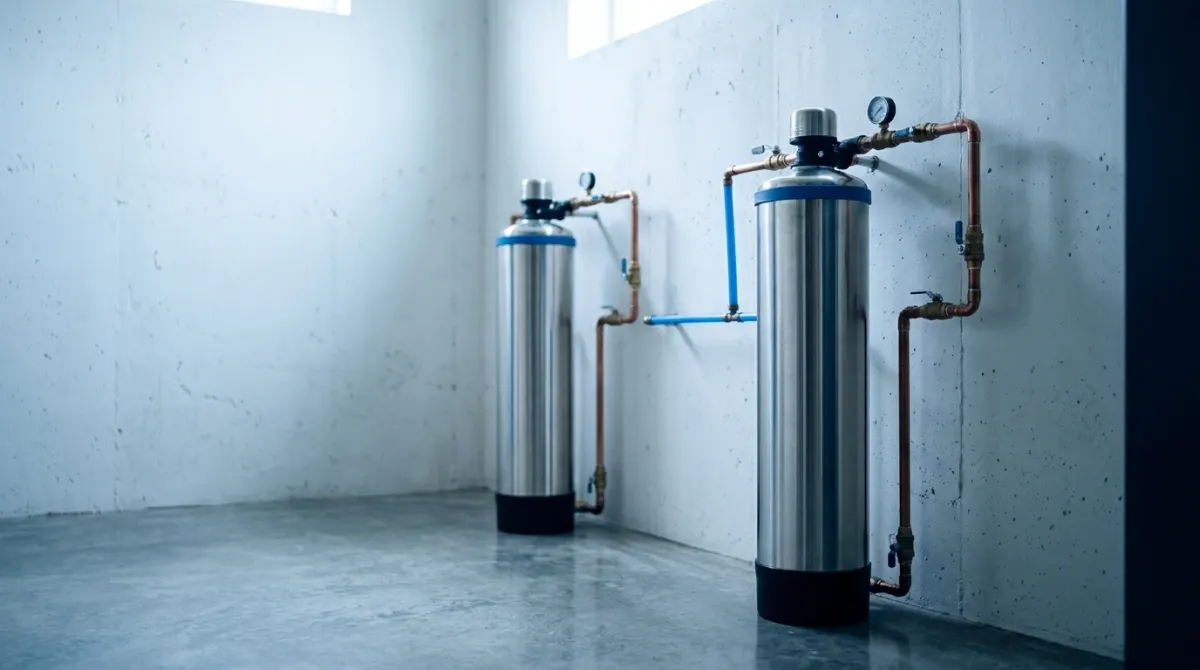
A whole-house carbon system for city water: activated carbon plus KDF-55 media rated for 1,000,000 gallons or 10 years, with a sediment prefilter ahead of it. Like the SpringWell CF1, it targets chlorine, taste, and odor. Unlike the CF1, the main tank is sealed — when the decade is up, you replace the tank rather than the media.
The numbers that decide it
| Checkpoint | Rhino EQ-1000 | Our read |
|---|---|---|
| Media life | 1,000,000 gal / 10 yr | Matches the class leader |
| Service flow | ~7 GPM published | The ceiling — felt in 3+ bath homes |
| Prefilter cadence | ~2 months | 6× the cartridge changes of the CF1 |
| End of life | Sealed tank — replace, not re-bed | Plan the year-10 cost now |
| Typical street price | $1,123 (watch for sitewide sales) | Routinely the cheapest of the three |
| 10-yr ownership | $1,500–$2,400 incl. install + prefilters | Prefilters quietly close the price gap |
The 10-year sealed-tank math
The Rhino's sealed-tank design is the feature most buyers overlook at purchase. The main filter tank cannot be re-bedded — at the end of its 10-year or 1,000,000-gallon life, you replace the entire tank. Aquasana's replacement tank runs in the $600–$900 range at typical street prices (plus installation labor if you used a plumber the first time).
By contrast, the CF1's tank is serviceable — if SpringWell were to ever offer a media replacement, or if you had a plumber re-bed it, the tank hardware itself could continue indefinitely. In practice, both systems end up in a similar cost range over a 20-year horizon, but the Rhino front-loads its value in the lower purchase price and back-loads cost in the year-10 tank replacement.
The prefilter cadence adds up faster than buyers expect. The Rhino's sediment prefilter needs replacement roughly every two months — about six times a year. At $15–$25 per cartridge, that's $90–$150 per year in prefilters, versus the CF1's $25–$40 per year for a 6–9 month replacement cycle. Over ten years, the prefilter gap alone adds $500–$1,100 to the Rhino's total cost of ownership.
Rhino vs CF1 in one table
| Spec | Aquasana Rhino EQ-1000 | SpringWell CF1 |
|---|---|---|
| Service flow | ~7 GPM | 9 GPM |
| Media life | 1,000,000 gal / 10 yr (sealed tank) | 1,000,000 gal (serviceable tank) |
| Prefilter cadence | ~2 months | 6–9 months |
| Typical street price | $1,123 | $1,170 |
| 10-yr total cost | $1,500–$2,400 | $1,350–$2,300 |
| Best for | 1–2 bath, 1–2 people on sale pricing | 2–4 bath, families, city water |
The full side-by-side argument lives in our SpringWell vs Aquasana comparison, which includes the flow math broken down by fixture type.
Prefilter cadence: the hidden cost line
The Rhino's 2-month prefilter interval is the detail most reviews bury. Aquasana's sediment prefilter protects the main tank from particulate fouling — a reasonable design choice — but the cartridge life is short compared to competitors. Six replacements per year means six trips to the filter housing, six potential O-ring checks, and six line items on your annual home maintenance budget. If you are on a subscription program the cartridges arrive automatically; if not, forgetting a replacement for a few months accelerates sediment loading on the main tank and degrades performance. It is a manageable task, but it is one the CF1 only asks you to do twice a year.
Who should buy it — and who will regret it
Buy itif you're one or two people in a one-or-two bath home on municipal water and you catch it on sale: the flow ceiling never gets tested, the media bed runs a decade, and the brand's support is established. Skip itif you run three or more bathrooms or a big-family Saturday-morning schedule — a ~7 GPM system serving stacked demand is how "we bought a filter" becomes "our showers got weak," and it's the single most common complaint pattern in owner forums. That story, with the math, is the whole CF1 vs Rhino verdict.
Verdict — 71/100
It depends — a genuinely solid filter behind a flow ceiling. Small homes on sale pricing: yes. Family houses: spend the extra $150 on headroom.
On well water, neither Rhino nor CF1 is the first move — start with what's actually in your well.
Questions owners actually ask
Are SpringWell water filters good?
SpringWell publishes specific media volumes, flow rates, and removal capacities — and those numbers hold up under scrutiny. The CF1 rates 9 GPM service flow and 1,000,000-gallon media life in its 1–3 bath configuration. Components are certified to industry standards, though the full system is not NSF-performance-listed. For city water, the CF1 earns a BUY at 92/100 on our scorecard. The WS1 earns the same verdict for iron and sulfur wells.
What is the highest rated home water filtration system?
On our scorecard, the SpringWell CF1 rates 92/100 for city water and the WS1 rates 90/100 for well water. The Aquasana Rhino scores 71/100 — not because it filters poorly, but because its ~7 GPM flow ceiling creates real pressure issues in 3+ bathroom homes. The highest-rated system depends on your water source: city water households get the most value from the CF1; well water households with iron and sulfur need the WS1 first.
Is SpringWell a good company?
SpringWell is a direct-to-consumer brand based in Tampa, Florida, that publishes specific capacity, flow, and removal data on its product pages — more than many competitors in the space. The main gap is full system-level NSF performance certification, which most direct-to-consumer brands skip due to cost. Their support reputation in owner forums is generally positive. We evaluate systems on published specs, not brand reputation, and the CF1 and WS1 both hold up on that basis.