Buyer's guide — well water
Water softener for well water:
why iron decides this, not hardness
On city water you buy a softener by hardness. On a well you cannot, because the thing most likely to kill the softener is not hardness at all — it is iron. Here is what to test, when you need a filter ahead of the softener, and how sizing changes once iron is in the water.
By Tim Parker — Reads the spec sheets and prices the full install
The single most expensive mistake on a well is buying the softener first. A softener sized purely on grains per gallon will work beautifully for a while, then quietly lose capacity, regenerate more and more often, and stop softening — because iron has been fouling the resin the whole time. The equipment was never wrong. The order of operations was.
Why well water breaks the normal softener advice
Municipal water arrives treated and filtered. Whatever else is wrong with it, somebody has already removed the sediment and dealt with the bacteria. Well water arrives exactly as the aquifer delivered it, which is why the same softener can be a ten-year appliance on city water and a two-year disappointment on a well.
Four things commonly ride along on a well, and a softener is designed to remove none of them: iron (orange staining), manganese (black staining), hydrogen sulfide (the rotten-egg smell), and sediment. Ion exchange targets calcium and magnesium. Everything else in that list either passes straight through or damages the resin on its way past.
Test before you shop — five numbers
You cannot pick equipment for a well without a water test, and a hardware-store test strip is not enough because it will not give you iron. Get these five:
- Hardness (grains per gallon) — sets the base sizing.
- Iron (ppm) — the number that decides whether a softener can stand alone.
- Manganese — black staining, and it fouls resin the same way iron does.
- pH — some iron filters simply will not work below certain pH, so this decides which filter is even eligible.
- Hydrogen sulfide — if you smell rotten eggs, this needs its own answer.
A certified lab test through your state cooperative extension or county health department costs a fraction of one wrong equipment decision. If the well has never been tested, is shallow, sits near farmland, or has ever flooded, add a bacteria test — that is the trigger for UV disinfection, and nothing else on this page addresses it.
The iron threshold: when a softener is not enough
A softener does pick up small amounts of dissolved iron incidentally — ion exchange is not fussy about which metal it grabs. That is why light-iron wells often run fine on a softener alone for years. But it is incidental, not designed, and it has a ceiling.
Past low single-digit ppm, or where iron has already oxidised into visible orange particles, the resin bed fouls. Capacity drops, regeneration frequency climbs, salt use climbs with it, and eventually the softener stops softening. At that point the fix is not a bigger softener — it is an iron filter installed ahead of it, so the softener only ever sees water the iron has already been removed from. Our full treatment of that problem, including air-injection systems and what they cost, is in iron in well water.
Sizing: iron eats capacity too
Base sizing is the same arithmetic as city water — people in the house, times daily water use, times hardness in grains per gallon, gives the grains you must remove per day, which sets the capacity you buy.
The well-specific adjustment is that iron consumes capacity as well, so the water treatment convention is to add several grains of apparent hardness for every ppm of iron before sizing. That is a rule of thumb rather than a measurement, which is precisely why it depends on having a real iron number instead of a guess. Undersizing is the most common well-water mistake: the system regenerates constantly, burns salt, and wears the valve out early.
The sodium question, if your well is already salty
A salt-based softener trades hardness minerals for sodium, so softened water always leaves with more sodium than it arrived with — and the harder the water, the more is added. On a well already testing high for sodium, that compounds. Two standard responses: run potassium chloride in the brine tank instead of sodium chloride, which does the same job without the sodium and costs meaningfully more (see softener salt), or leave an unsoftened line to the kitchen tap so drinking and cooking water bypasses the system. If anyone in the house is on a sodium-restricted diet, raise this specifically before you buy. A salt-free conditioner avoids the sodium entirely, but it does not actually remove hardness — worth understanding before you treat it as a substitute.
What to buy, in the order you should buy it
With a test in hand the decision is usually straightforward:
- Hard water, little or no iron — a softener on its own, sized normally. This is the city-water playbook and our picks are in the best water softener guide.
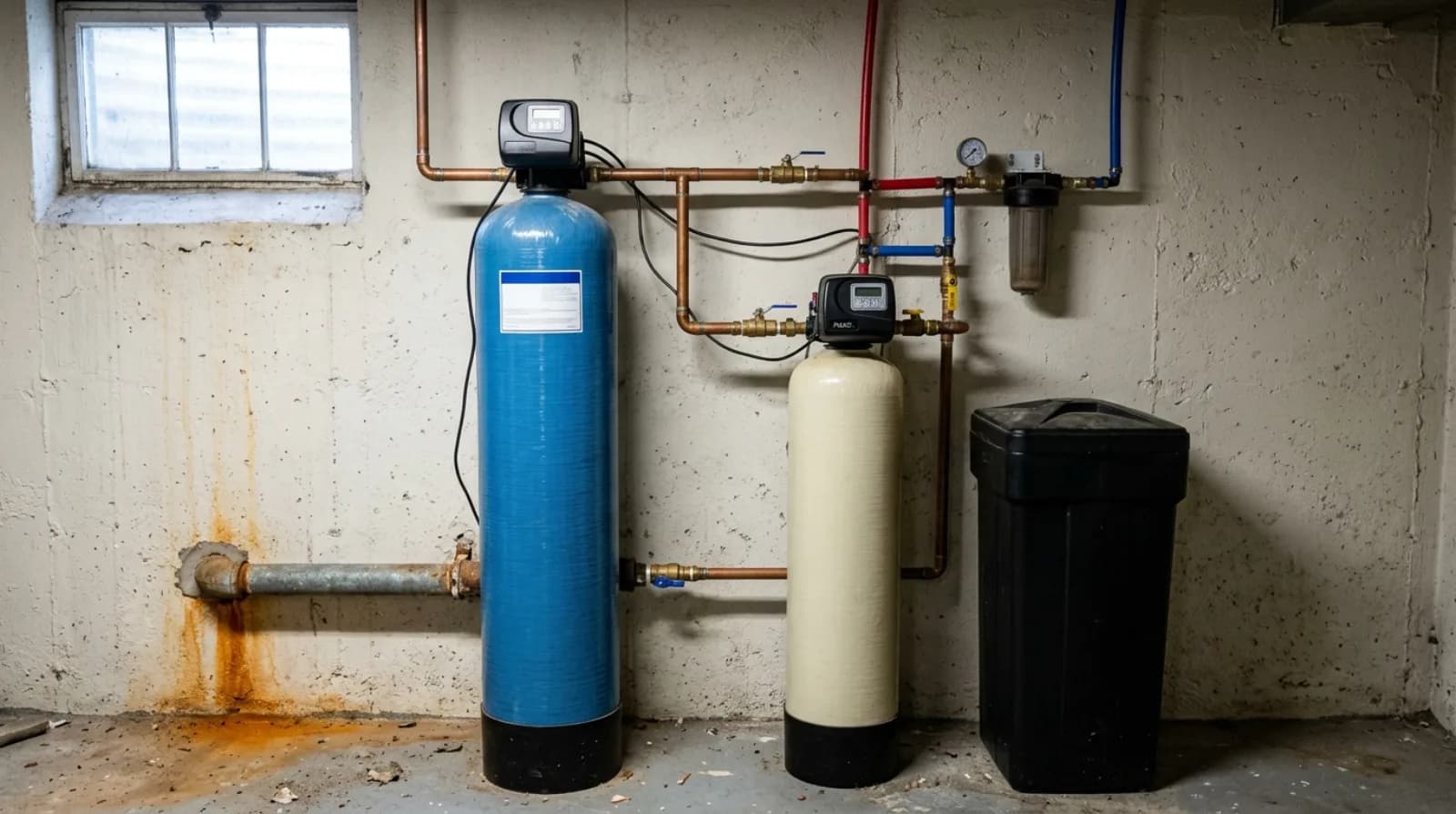
- Hard water plus real iron — iron filter first, softener second, sized with the iron compensation. Two units, in that order.
- Iron plus rotten-egg smell — air injection handles both at once, which is the arrangement covered in iron in well water.
- Any positive bacteria result — UV, in addition to everything above. Filtration does not disinfect.
For the softener half of that, the most transparent path is a Fleck-valve system you can price before you commit — the same valve family the well-water regulars on water treatment forums push newcomers toward, because parts are everywhere and any plumber can service it:
Before you sign anything from a dealer instead, read why there is no Culligan price tag — on a well the dealer sizing conversation is genuinely more useful than on city water, but you still want the quote itemised and comparable. And check the whole number against what softeners really cost installed before you assume the equipment price is the price.