Water Treatment — Salt-Free
Saltless Water Softener: What It Actually Does to Scale
Say it plainly: a salt-free softener doesn't remove hardness. It's a conditioner. Here's what it actually does, and where that's the right trade.
By Tim Parker — Reads the spec sheets and prices the full install
A saltless water softener is not a softener — it's a conditioner. It does not remove hardness minerals from your water. It changes how dissolved calcium behaves so it's less likely to form scale. Test your water before and after installing one, and the hardness number will read the same both times.
What "saltless water softener" actually means
The name is the problem. These systems are sold as softeners because that's what people search for, but the mechanism is entirely different from ion exchange. A real softener pulls calcium and magnesium ions out of the water and replaces them with sodium, using a resin bed and a brine tank — that's a chemical removal process, and it's what the salt in the brine tank is for. A saltless system, most commonly using template-assisted crystallisation (TAC) media, doesn't remove anything. It converts dissolved calcium into microscopic crystals that stay suspended in the water instead of bonding to surfaces. No brine, no drain line, no sodium added, no salt bag to carry. But also: no reduction in hardness. The mineral content of your water leaving the conditioner is the same as the mineral content going in. That's not a marketing spin — it's the whole mechanism, and it's the single thing anyone shopping for a saltless softener needs to know before they buy.
What it's good at: scale protection
Scale — the white crust that builds up in water heaters, on shower heads, inside pipe fittings — forms when dissolved calcium bonds to a hot surface and crystallizes there. TAC media disrupts that bonding process, so the calcium passes through as tiny, stable crystals instead of latching onto your water heater's heating element. Where a conditioner genuinely earns its place: no access to a drain for a softener's regeneration cycle, a small utility closet with no room for a brine tank, a rental where installing permanent equipment isn't practical, a household avoiding added sodium for dietary reasons, or simply not wanting the ongoing chore of buying and loading salt bags. It's also effectively maintenance-free compared to a softener — no bridging, no brine tank to clean, no salt to run out of.
What it can't do: give you soft water
If what you actually want is the slick feel of soft water, a real reduction in how much soap and detergent you use, an end to soap scum and spotting on dishes and glassware, or protection for appliances on genuinely hard water — a conditioner will not deliver any of that, because the hardness minerals never leave the water. NSF/ANSI 44 is the certification standard for softening performance, and it applies to ion-exchange equipment, not to conditioners; there's no equivalent third-party performance certification proving a conditioner reduces hardness, because it isn't designed to.
The evidence for scale protection also thins out as hardness climbs. On moderately hard water, a well-installed TAC conditioner is a reasonable scale-control option. On severely hard water — the kind that leaves visible crust on faucets within weeks — the case for conditioning alone protecting a water heater or dishwasher over years gets much less solid, and ion exchange is the more reliable fix. If you already see scale, spotting, or soap that won't lather, those are hardness symptoms a conditioner does not resolve. Confirm what hard water is actually costing you before choosing between the two.
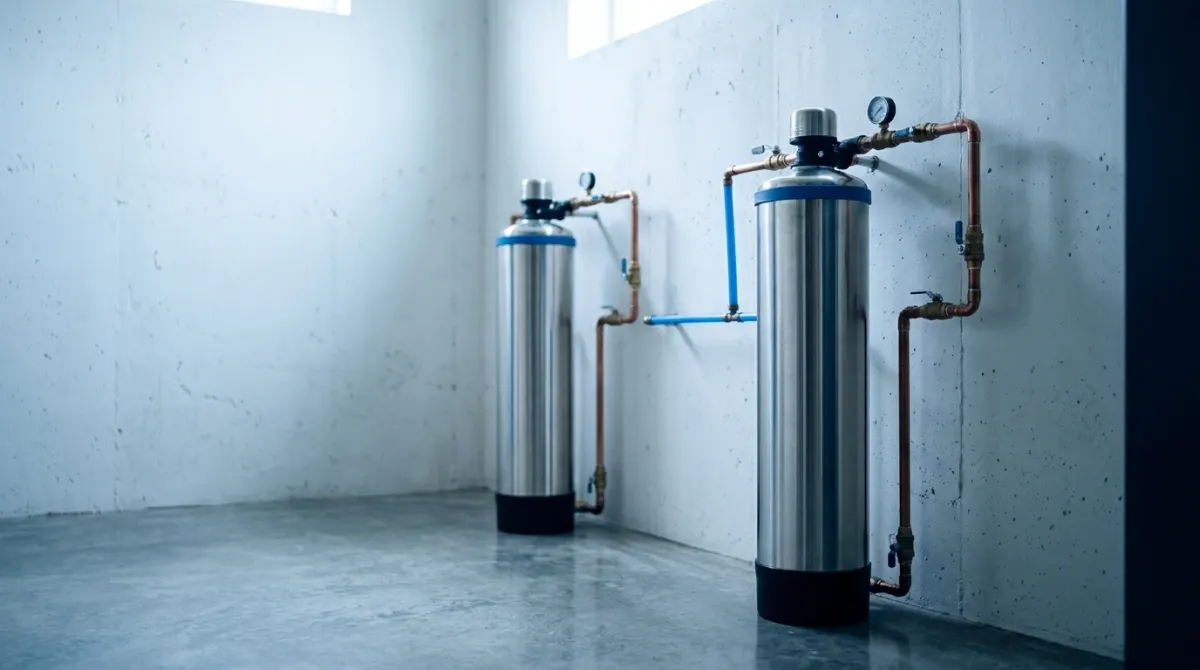
If a conditioner is the right trade for your situation — no drain access, no room for a brine tank, avoiding added sodium — a TAC unit like the one below is what that category looks like in practice. It inhibits scale. It does not remove hardness, and nothing in this box changes that.
Conditioner vs softener: the honest comparison
| Saltless conditioner | Salt-based softener | |
|---|---|---|
| Removes hardness minerals | No | Yes |
| Reduces scale buildup | Yes | Yes |
| Soft-water feel, less soap use | No | Yes |
| Needs a drain line | No | Yes |
| Adds sodium to water | No | Yes |
| Ongoing consumable | None | Salt, $100-$300/yr |
| NSF/ANSI 44 certifiable | No | Yes |
Installed cost for both, line by line, is on the cost hub.
Does it work on well water?
TAC conditioners are rated for hardness, not for the other things a well can carry. Iron, manganese, and sediment aren't addressed by a saltless conditioner at all — they pass straight through, and heavy iron can foul the TAC media the same way it fouls resin in a salt-based softener, just without a regeneration cycle to flush it clear. On a well with both hardness and iron present, the iron gets treated upstream first, same as it would ahead of a salt-based softener; a conditioner is not a substitute for an iron filter, and expecting it to handle both is a common and avoidable disappointment.
Installation is simpler, and that's real money
One genuine practical advantage: a conditioner is typically plumbed inline with no drain line and no brine tank, because it isn't regenerating anything with salt. That skips a meaningful chunk of the labor a salt-based softener install requires — see what a full softener installation involves for the comparison. It also means no bypass valve juggling during service, no floor drain or standpipe requirement, and nothing that can bridge or mush in a brine tank because there isn't one. None of that changes what the unit does to your water hardness — it just makes the box on the wall cheaper to install and simpler to live with.
Ongoing maintenance is genuinely lower
A conditioner has no brine tank, so it has none of the recurring upkeep a salt-based softener needs — no salt to buy or haul, no bridging or mushing to check for, no brine tank to clean out annually. Most TAC media is rated to last several years before the cartridge or media bed needs replacing, and there's no monthly check the way there is with softener maintenance. That's a genuine, non-marketing advantage of the technology — it's just a different trade than the hardness-removal one, and worth weighing on its own merits rather than as a reason to believe it softens water.
Watch for these marketing tells
A listing that says "softens" or shows a before/after hardness test without naming the certification standard is the pattern to be skeptical of. Legitimate conditioner manufacturers are usually upfront that they treat scale, not hardness, and cite independent scale-reduction testing rather than a softening claim. If a saltless product page claims it removes hardness minerals or cites NSF/ANSI 44 — the ion-exchange softening standard — read that claim carefully; it's either describing a different kind of product or overstating what the technology does.
How to decide
Ask what you're actually solving. If the goal is protecting a water heater and pipes from scale without salt, a drain line, or sodium in the water — and your hardness isn't severe — a conditioner is a legitimate, lower-maintenance choice. If the goal is soft water itself, or your hardness is high enough that you're already seeing scale and spotting, a salt-based softener is the fix that actually removes the mineral causing the problem. See our water softener buying guide for current salt-based hardware picks once you've made that call.
Where to go next
Water softener installation
What the job involves if you decide ion exchange is the right call.
Fix My Water
Diagnose what's actually wrong with your water before you buy anything.
Common questions
Does a saltless water softener actually soften water?
No. A saltless system is a conditioner, not a softener. It changes the form dissolved calcium and magnesium take through a process like template-assisted crystallisation, so the minerals are less likely to stick to pipe and appliance surfaces. Test the treated water and the hardness number reads the same as it did going in, because nothing was removed.
Why is it called a softener if it doesn't soften?
Marketing, mostly. Manufacturers sell these as "salt-free softeners" because the shopper is searching for a softener and the product sits in the same aisle. The more accurate industry term is a scale control system or conditioner. NSF/ANSI 44, the standard that certifies softening performance, applies to ion-exchange units — not to conditioners.
Will a saltless conditioner protect my appliances from hardness?
It helps against scale buildup in water heaters, pipes and fixtures, which is the main damage hard water does. It does not deliver the soft-water feel, the drop in soap and detergent use, or the reduction in spotting on dishes and glassware that ion exchange provides, because the hardness minerals are still in the water.
When does a salt-free conditioner make sense over a real softener?
When you can't run a drain line, don't want to haul and load salt, want to avoid added sodium in the water, or you're renting and want a low-maintenance option. It's also common where local rules restrict softener discharge into septic systems or drain lines.
When is a salt-free conditioner the wrong choice?
When you already have visible scale, spotting, or soap that won't lather well — those are hardness symptoms that only ion exchange resolves, because it removes the minerals rather than just changing their behavior. On very hard water, the evidence that conditioning alone protects appliances gets thin, and a salt-based softener is the more reliable fix.
All pillars
Water Treatment · Well & Pumps · Sump & Basement · What It Really Costs