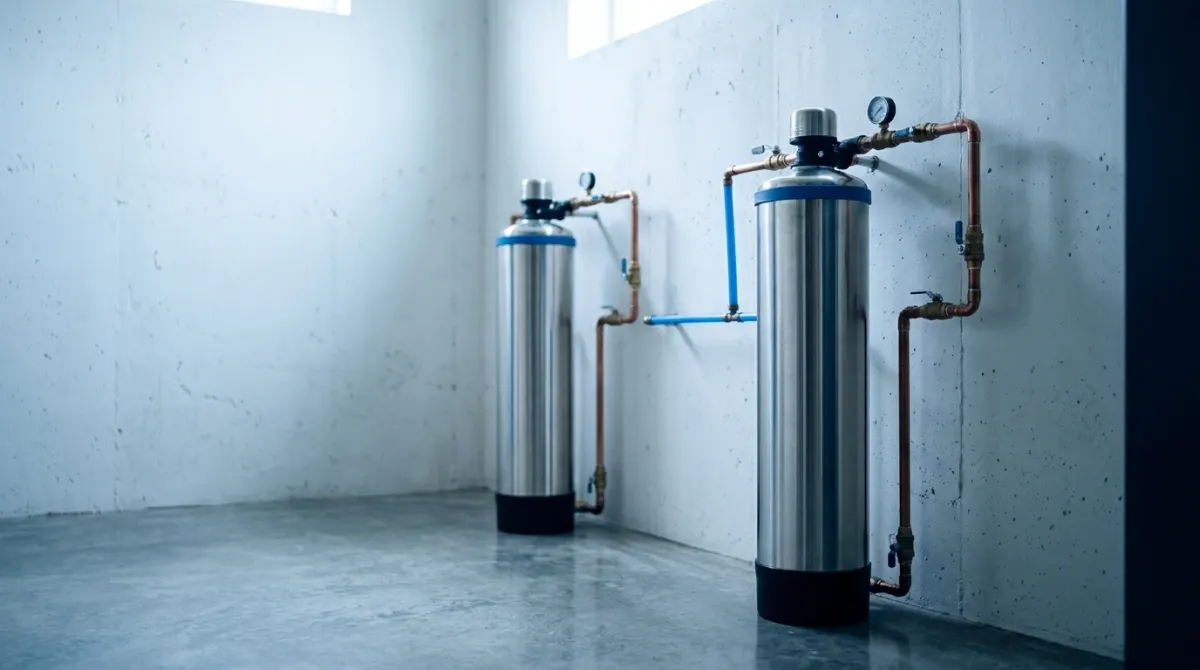
Water Treatment — Installation
Water Softener Installation: DIY vs. Plumber, and the Real Cost
Labor runs $400-$700 alone. Here's what a plumber actually does for that money, the honest DIY call, and every place a first-time install goes wrong.
By Tim Parker — Reads the spec sheets and prices the full install
A water softener installed costs $1,400-$2,500 all-in: $600-$1,200 for the unit, $400-$700 in plumber labor, plus a bypass valve, fittings and a drain line. The job itself is a few hours of plumbing for a house that already has a loop near the main — much longer if it doesn't.
What the job actually involves
The installer finds a point on the main supply line after the meter (or after the pressure tank on a well) and before the water heater — softening water after it's already been heated wastes energy and lets scale form in the tank first anyway. From there the job is: cut into the main, plumb in a bypass valve, set the unit level on a stable base, connect the drain line for the regeneration cycle, wire the control valve to power, and program the regeneration schedule to your household's hardness and usage. On a house already plumbed with a softener loop, that's a two-hour job. On a house without one, the installer has to reroute copper or PEX to reach the unit and find a drain within reach of the discharge line, and that's what turns a $500 quote into $1,200 — see the full breakdown on what a water softener really costs.
Getting multiple quotes
Because labor is the variable that swings a quote the most, get at least two plumbers to look at the actual install location before quoting, not just the unit model. Ask each to itemize unit, labor, bypass valve, and drain line separately rather than quoting one lump sum — that's the only way to tell whether one quote is cheaper because the plumber is faster, or cheaper because they left out the bypass valve. A quote that's dramatically below the $400-$700 labor range on a house with no existing loop is worth a second look at what it's actually including.
DIY vs plumber: the honest decision
Cutting into a main water line is not exotic plumbing — a homeowner comfortable soldering copper or gluing PEX-A fittings can physically do this job. What makes it worth outsourcing is what happens when it goes wrong. A bad solder joint or a fitting that weeps under pressure floods a utility room or basement while you're at work, not while you're watching it. And most manufacturer warranties on softener valves and resin tanks specifically require professional installation to stay valid — DIY the install and a failed valve six months in may not be covered.
The real cost comparison: DIY saves the $400-$700 labor line but keeps the risk of a flood and a voided warranty. A plumber costs that $400-$700 and removes both. For a first-time install on a house with no existing loop — the harder, more expensive version of this job — hiring out is the safer default. For a straightforward swap of an old unit for a new one on an existing loop, an experienced DIYer with the right fittings can reasonably do it themselves, provided they check the warranty terms first.
Bypass valve: not optional
Every installation needs a bypass valve — it lets the house run on untreated water while the softener is serviced, regenerates, or fails outright, instead of leaving the whole house without water. Some units ship with one built into the head; others need a separate valve plumbed in. If a quote doesn't mention it, ask — a softener installed without a bypass is not a finished job, it's a future service call that requires shutting off the main.
Drain requirements
Regeneration flushes brine and rinse water down a drain line, so the unit needs to reach one: a nearby floor drain, a standpipe, or a utility sink. Local code often requires an air gap at the drain connection so wastewater can never siphon back into the softener — this is one of the two questions worth asking a plumber before signing a quote, along with whether the bypass valve is included. Both are cheap to plan for and expensive to discover halfway through the job.
Permit reality
Whether a softener install needs a permit depends entirely on the jurisdiction, and usually hinges on the drain tie-in rather than the softener itself. Some municipalities require a permit and inspection for any new connection to the wastewater system; plenty of others don't regulate residential softener installs at all. There is no national default here — call the local building department rather than assume either answer.
Salt-based vs salt-free: does the install differ?
Yes, and it's worth knowing before you book anyone. A salt-based unit needs the full list above: bypass valve, drain line for the regeneration discharge, and a control valve wired to power. A salt-free conditioner typically skips the drain line entirely, because it doesn't regenerate a resin bed with brine — it's plumbed inline and conditions water as it passes through. That's a real chunk of the labor cost, which is why conditioner installs generally land at the lower end of the ranges on the cost hub. The trade-off is the one covered on that page: a conditioner doesn't remove hardness, it manages scale. Pick the equipment based on what you're solving, not on which one is cheaper to plumb in.
Replacing an old unit vs a first install
Swapping an existing softener for a new one is a different job from installing one where none existed. If the old unit's bypass valve, fittings, and drain line are already in place and in good condition, a plumber can usually disconnect the old tank and connect the new one in under two hours, near the low end of the labor range. What extends the job even on a swap: fittings sized for an old unit's inlet/outlet spacing that don't match the new one, a bypass valve that's corroded or seized and needs replacing anyway, or a drain line that was never up to code and gets flagged during the swap. Ask whether the quote assumes a straight swap or includes an allowance for fitting mismatches — it's the most common reason a "simple replacement" quote grows once the plumber is under the sink.
What goes wrong
The recurring failure modes: no bypass valve, so any service call means shutting off water to the whole house. A drain line without an air gap, which fails inspection in jurisdictions that check for it. A unit installed after the water heater instead of before it, so the heater scales up anyway. And undersizing the unit to the household's actual hardness and water use — worth confirming against the sizing guidance on the water treatment pillar before you buy, not after the plumber has already cut the pipe.
This site's product registry does not yet carry a salt-based softener unit, so no buy box for the hardware ships on this page — see our water softener buying guide for current picks, or confirm hard water is your problem before you book an install.
Where to go next
Water softener maintenance
Salt top-up cadence, resin bed cleaning, and service intervals once it's installed.
How much is a water softener?
The full installed-cost breakdown this page's figures come from.
Common questions
How much does water softener installation cost?
Labor alone runs $400-$700 on a straightforward job, and $1,400-$2,500 all-in once you add the $600-$1,200 unit and the bypass valve, fittings and drain line. A house with no existing softener loop near the main runs higher, because the plumber has to reroute pipe to reach the unit.
Can I install a water softener myself?
Physically, often yes. But it means cutting into the main supply line, and a mistake floods the house. Many manufacturer warranties require professional installation to stay valid, and some jurisdictions require a permit for the drain connection. Read the warranty terms before deciding the labor line is optional.
Where does a water softener need to go?
As close as possible to where the main water line enters the house, and before the water heater — softening water after it's been heated wastes energy and lets scale form in the tank first. It needs a bypass valve, a nearby drain (floor drain, standpipe, or utility sink) for the regeneration cycle, and a grounded electrical outlet for the control valve.
Do I need a permit to install a water softener?
It depends on your jurisdiction, not on the softener. The drain connection is usually the trigger, since it ties into wastewater plumbing. Some municipalities require a permit and inspection for any new drain tie-in; others don't regulate softener installs at all. Call your local building department before you assume either way.
All pillars
Water Treatment · Well & Pumps · Sump & Basement · Fix My Water