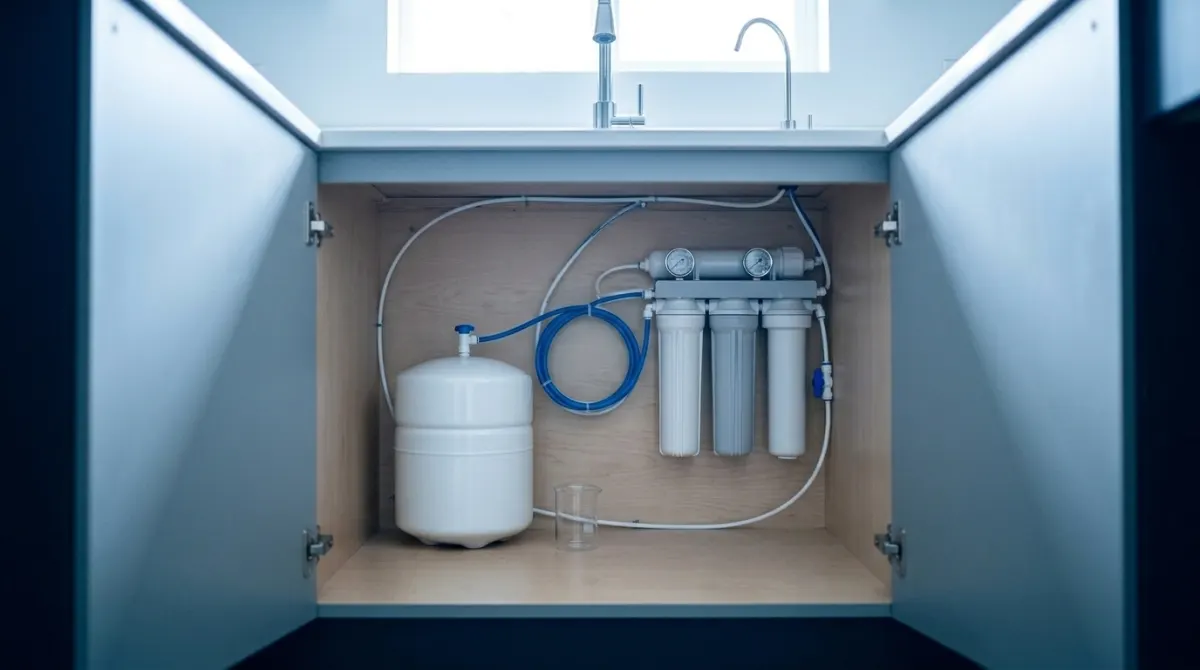
Head-to-Head — Under-Sink RO 2026
Best under-sink RO:
tankless vs tank, one winner per use case
Three under-sink RO systems on the same spec sheet: the Aquasana SmartFlow (certified PFAS layer), Waterdrop G3 P800 class (high-efficiency tankless), and iSpring RCC7 class (budget-proven tank). Different winners for different problems.
By Tim Parker — Reads the spec sheets and prices the full install
The three systems
Aquasana SmartFlow RO— Aquasana's current under-sink RO (formerly marketed as OptimH2O). Tankless design. Aquasana states it is tested and certified to reduce up to 99.99% of 90 contaminants, specifically including PFOA and PFOS. Pairs RO membrane with Claryum carbon stage. Typical street price approximately $200–$450 before installation. See the full review at Aquasana SmartFlow RO review.
Waterdrop G3 P800 class— Waterdrop's flagship tankless under-sink RO system. Published daily output per manufacturer: 800 gallons per day (GPD). Tankless design with composite filter construction. Waterdrop publishes NSF certifications for this product line — verify current standard numbers and contaminant coverage at waterdropfilter.com and nsf.org/certified-products before purchasing. Typical street price approximately $400–$600.
iSpring RCC7 class — the benchmark for traditional 5-stage tank RO. NSF 58-certified (verify current model listing at nsf.org). Uses a 3.2-gallon pressurized storage tank under the sink. Proven, widely installed, extensively reviewed. Typical street price $150–$250.
Head-to-head on the specs that decide it
| Spec | Aquasana SmartFlow | Waterdrop G3 P800 | iSpring RCC7 class |
|---|---|---|---|
| Tank vs. tankless | Tankless | Tankless | Tank (3.2 gal storage) |
| PFOA/PFOS reduction | Yes — per Aquasana certified claims | Verify at waterdropfilter.com + nsf.org | NSF 58 covers many contaminants — check specific contaminant list for PFAS |
| NSF certification | Per Aquasana published specs — verify at nsf.org | Per Waterdrop published specs — verify at nsf.org | NSF 58 certified (verify current model listing) |
| Contaminants reduced | Up to 99.99% of 90 (per Aquasana) | Per Waterdrop published specs | Per iSpring published specs; NSF 58 covers core list |
| Typical waste ratio | Per manufacturer — verify at aquasana.com | Per manufacturer — Waterdrop publishes efficiency claims | ~3:1 to 4:1 (traditional tank design) |
| Filter replacement cost (annual est.) | ~$50–$150/yr — verify with Aquasana for your model | ~$80–$150/yr — verify at waterdropfilter.com | ~$40–$80/yr for prefilters + annual post-filter; membrane ~$30–$50 every 2–3 yrs |
| Upfront system cost (typical) | ~$200–$450 | ~$400–$600 | $150–$250 |
| Cabinet space required | Compact — no tank | Compact — no tank | Significant — 3.2-gal tank plus filter housings |
Prices above are typical street-price ranges. Verify current pricing, exact certification scope, and current model specifications at each manufacturer's website and at nsf.org/certified-products before purchasing. Specifications are updated periodically.
Winner by use case
For PFAS-focused households
Winner: Aquasana SmartFlow RO
Aquasana specifically lists PFOA/PFOS reduction in their certified contaminant claims. For households where PFAS is a documented concern and you want a named certification for those specific compounds, the SmartFlow is the most direct answer. It pairs with a whole-house carbon filter as the second layer of the two-layer PFAS strategy (see PFAS guide).
For high-efficiency tankless without PFAS priority
Evaluate: Waterdrop G3 P800
If cabinet space is tight, tankless convenience matters, and your primary concern is broad contaminant reduction rather than a specific PFAS certification, the Waterdrop G3 P800 class is worth a direct spec comparison at waterdropfilter.com. Verify their current NSF certification scope and waste ratio claims against your priorities before purchasing. We break down the published specs — 800 GPD, the 3:1 pure-to-drain ratio, and NSF/ANSI 58 & 372 certification — in the full Waterdrop G3 P800 review.
For budget-conscious buyers
Winner: iSpring RCC7 class
At $150–$250 with NSF 58 certification, the iSpring RCC7 class has the longest track record in the category. The tank takes up cabinet space and the 3:1–4:1 waste ratio is higher than modern tankless systems, but the upfront cost is roughly half of the tankless options and the contaminant reduction is well-documented. Maintain membrane replacement intervals — this is where owner complaints originate, not the technology itself.
What all three share
All three are point-of-use systems — one tap. They do not provide whole-house coverage. Shower water, laundry, ice maker (unless plumbed to the RO line), and outdoor taps are not covered. For households with PFAS concerns, the under-sink RO is the certified endpoint for drinking and cooking water, and a whole-house carbon filter provides the broader household coverage layer. See the PFAS guide for the full two-layer strategy.
All three remove minerals along with contaminants — calcium and magnesium are rejected by the RO membrane. Most households get minerals primarily from food; this is generally not a health concern. If mineral content is important to you, look for a model with a remineralization post-filter stage.
Questions owners actually ask
What is the best under sink reverse osmosis system?
For PFAS-focused buyers who want certified reduction at the kitchen tap: the Aquasana SmartFlow RO, which Aquasana states is tested and certified to reduce PFOA and PFOS specifically. For buyers who want a high-efficiency tankless system and a strong contaminant list without prioritizing a specific PFAS certification: the Waterdrop G3 P800 class is worth evaluating. For budget-conscious buyers who want a proven NSF 58-certified RO at the lowest upfront cost: the iSpring RCC7 class of 5-stage tank systems delivers reliable performance at $150–$250. Verify current certifications for any system at the NSF certified products database before purchasing.
Is a tankless RO system better than a tank RO?
Tankless RO systems produce water on demand without a storage tank, which eliminates two drawbacks of tank designs: the cabinet space consumed by a pressurized storage tank (typically 3–5 gallons under the sink), and the bacterial risk associated with stagnant water in a tank when membrane replacement intervals are missed. The tradeoff: tankless systems cost more upfront ($200–$500 vs $150–$250 for tank systems), and some produce water more slowly than a pressurized tank at the moment of demand. For most households, the tankless advantages justify the cost difference. For buyers on a tight budget who will maintain membrane replacement intervals, a quality tank system delivers equivalent water quality.
How much water does a reverse osmosis system waste?
Traditional 5-stage tank RO systems like the iSpring RCC7 typically produce 1 gallon of filtered water for every 3–4 gallons sent to drain — a 3:1 or 4:1 waste ratio. Modern high-efficiency tankless systems have improved significantly: some claim ratios approaching 1.5:1 or even lower under ideal conditions. The waste water goes to drain (typically the sink drain via a saddle valve). For most households, RO waste water is a small fraction of total daily usage. If water cost or conservation is a concern, compare the published waste ratios for specific models rather than relying on category generalizations.
How often do you need to replace RO filters?
RO systems typically have multiple filter stages with different replacement schedules. Pre-filters (sediment and carbon) that protect the membrane are usually replaced every 6–12 months. The RO membrane itself typically lasts 2–3 years under normal usage. Post-filters (polishing carbon) are usually replaced annually. These intervals vary by usage volume, incoming water quality, and manufacturer specifications — check the published schedule for your specific model. A system with missed membrane replacements loses rejection efficiency quietly; contaminant reduction drops before you can taste a difference, which is why scheduling replacements on the manufacturer's calendar is important.
The winner of this comparison, ready to order: