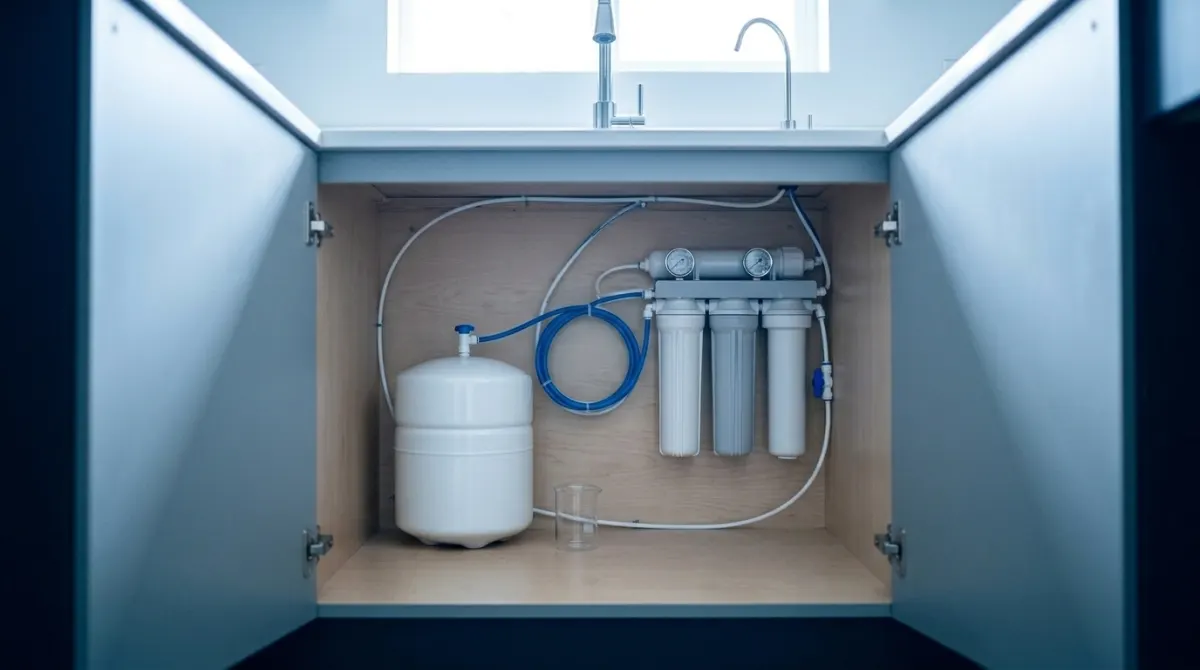
Verdict: BUY — the certified PFAS layer · Score 87/100
Aquasana SmartFlow RO:
NSF PFAS certification, specs and cost
Aquasana's under-sink reverse osmosis is tested and certified to reduce PFOA and PFOS specifically — the certification gap that whole-house carbon systems leave open. Here is what the cert actually covers, where the system fits, and what it costs over ten years.
By Tim Parker — Reads the spec sheets and prices the full install
The context first
This page originally reviewed the Aquasana OptimH2O AQ-RO-3.56. That listing is discontinued — Amazon marks it “Currently unavailable. We don't know when or if this item will be back in stock.” Aquasana replaced it with the SmartFlow Reverse Osmosis system, which is what this review now covers. The core technology carries over: a tankless under-sink RO system that pairs reverse osmosis membrane filtration with their Claryum carbon-based stage. According to Aquasana's published product information, the system removes up to 99.99% of 90 contaminants, specifically including PFOA and PFOS reduction.
For the full, current certification scope — including which NSF/ANSI standards apply and which specific contaminants are covered — verify the exact model at aquasana.com and cross-reference with the NSF certified products database at nsf.org/certified-products. Certification scope is updated periodically; the NSF database is the authoritative source.
What an RO system actually does differently
Carbon filtration — including the catalytic carbon in whole-house systems — reduces PFAS and many other contaminants at useful levels. But reverse osmosis adds a semi-permeable membrane stage that physically rejects dissolved molecules above a certain size, which is why RO systems can credibly claim documented removal of contaminants that carbon alone cannot reliably capture: nitrates, arsenic, fluoride, dissolved salts, and the full PFAS panel at point-of-use flow rates where testing protocols are designed to run.
The tradeoffs: RO wastes some water in the process (the concentrate stream that carries rejected contaminants to drain), takes up cabinet space, and removes beneficial minerals along with contaminants. Modern tankless designs have improved on all three relative to older tank-based systems. The SmartFlow uses a tankless configuration — no storage tank, water produced on demand — which eliminates the pressure drop and bacterial growth risk associated with stagnant tank storage.
The numbers
| Checkpoint | SmartFlow RO | Our read |
|---|---|---|
| Contaminants reduced | Up to 99.99% of 90 (per Aquasana published specs) | Broader contaminant list than carbon-only under-sink systems |
| PFOA/PFOS reduction | Yes — included in Aquasana's certified contaminant list | Verify current NSF cert scope at nsf.org for exact standard number |
| Tank configuration | Tankless (on-demand production) | No stagnant storage; no pressure-tank maintenance |
| Filter stages | RO membrane + Claryum carbon stage (per Aquasana published product description) | Multi-stage: pre-sediment, RO membrane, carbon polishing |
| Typical street price | $199.99 (system only; confirm current pricing at aquasana.com) | Watch for sitewide sales — Aquasana discounts regularly |
| Pro install (under-sink) | $150–$350 typical plumber quote | Confident DIYers can install in 2–3 hours with supply lines and a drain saddle |
| Filter replacement cost | Varies by model and stage; per manufacturer's published replacement schedule | Budget $50–$150/yr for membrane and post-filter — confirm with Aquasana for your model |
Where it fits: the two-layer PFAS strategy
As explained in the PFAS guide, the most defensible approach for PFAS-affected households combines two layers:
- Whole-house catalytic carbon filter — reduces PFAS (plus chlorine, VOCs, taste, odor) throughout the home. This layer handles shower water, laundry water, and everything else. Most do not carry a formal PFAS certification at whole-house flow rates, but catalytic carbon demonstrably reduces PFAS. (See SpringWell CF1 review.)
- Certified under-sink RO at the kitchen tap — the Aquasana SmartFlow RO is this layer. It provides a certified, documented reduction endpoint for your drinking and cooking water specifically.
This combination costs roughly $1,800–$2,700 all-in installed. The annual ongoing cost is approximately $75–$190: ~$25–$40 for the whole-house prefilter plus ~$50–$150 for the RO membrane and post-filter replacements. That is the price of documented performance at every point in the chain.
If your concern is PFAS specifically and you do not already have a whole-house filter, the SmartFlow RO alone addresses the highest-exposure point — drinking and cooking water — at considerably lower cost than a whole-house system. It is not a substitute for whole-house reduction (your shower water and laundry water are separate), but it handles the highest-volume drinking water exposure with a certified system.
What RO does not do
It is a point-of-use system. One tap. Shower water, laundry, ice maker (unless plumbed to the RO line) — none of these are covered. For whole-house PFAS reduction, you need the whole-house layer.
It removes minerals. RO membranes reject calcium and magnesium along with contaminants. The resulting water is soft and essentially mineral-free. For most households this is not a health concern — minerals come primarily from food, not water — but if you prefer mineralized water, look for a version with a remineralization post-filter stage.
It uses some water. All RO systems produce a concentrate stream — water that carries rejected contaminants to the drain. Modern tankless systems have better water efficiency than older tank designs, but there is always some waste-water. Confirm the specific ratio for your model at aquasana.com.
SmartFlow RO vs. standard tank RO (iSpring RCC7 class)
Traditional tank RO systems like the iSpring RCC7 (and similar 5-stage units under $200) are NSF 58-certified and effective, but they use a pressurized storage tank under the sink. The tank takes up significant cabinet space, and standing water in the tank can be a bacteria risk if membrane replacement intervals are missed. Tankless designs like the SmartFlow eliminate both issues at a higher upfront price. For the full three-way comparison, see our under-sink RO head-to-head.
Verdict — 87/100
BUY as the certified drinking-water layer in a two-layer PFAS strategy.
Verify current certification scope at aquasana.com and nsf.org/certified-products before purchasing — certification details are updated periodically and the fine print matters. For the full PFAS strategy context: PFAS Reduction at Home, Handled Honestly. For the head-to-head against Waterdrop and iSpring: Best Under-Sink RO Comparison.
Questions owners actually ask
Does Aquasana remove PFAS?
Aquasana states that their SmartFlow Reverse Osmosis system is tested and certified to reduce PFOA and PFOS specifically, and removes up to 99.99% of 90 contaminants total. For the current certification scope and exact standard numbers, verify directly on Aquasana's website or the NSF certified products database at nsf.org — certification listings are updated periodically and the detail matters more than marketing language.
Is reverse osmosis water safe to drink every day?
Yes. Reverse osmosis removes a broad spectrum of contaminants — heavy metals, PFAS, nitrates, chlorine, arsenic, and many others — and produces water that is safe and typically tasteless. The main nutritional note: RO removes most dissolved minerals, including calcium and magnesium. Most people get these minerals from food, not water, so this is rarely a health concern. If you want minerals restored, some RO systems include a remineralization stage. For health guidance on drinking water quality, see epa.gov.
What is the difference between Aquasana Claryum and reverse osmosis?
Claryum is Aquasana's carbon-based under-sink filtration technology. It handles chlorine, chloramines, heavy metals, pesticides, microplastics, and PFAS — and it retains beneficial minerals like calcium and magnesium. Reverse osmosis goes further: it removes a broader contaminant list including nitrates, arsenic, fluoride, and dissolved solids that carbon cannot capture, but it also removes minerals and wastes some water in the process. For PFAS reduction at the tap, both technologies reduce PFOA/PFOS; for documented PFAS results at the highest reduction level, the RO system is the stronger choice.
Does a whole house filter eliminate the need for under-sink RO?
No — they serve different functions. A whole-house catalytic carbon filter reduces chlorine, VOCs, taste, and odor at every tap and reduces PFAS throughout the home, but it does not remove dissolved solids, nitrates, arsenic, or fluoride, and most do not carry a formal NSF P473 PFAS certification at whole-house flow rates. An under-sink RO system at the kitchen tap provides a certified, high-reduction endpoint for drinking and cooking water. For households where PFAS is a documented concern, the two-layer approach — whole-house carbon plus certified under-sink RO — is the most defensible strategy.