Verdict: BUY — high-efficiency tankless · Score 86/100
Waterdrop G3 P800 review:
800 GPD tankless RO specs, waste ratio and cost
The G3 P800 is Waterdrop's flagship under-sink RO: 800 gallons a day, a published 3:1 pure-to-drain ratio, and NSF/ANSI 58 & 372 certification. Here's the full spec read — including the one place the Aquasana SmartFlow still earns the nod.
By Tim Parker — Reads the spec sheets and prices the full install
What it is
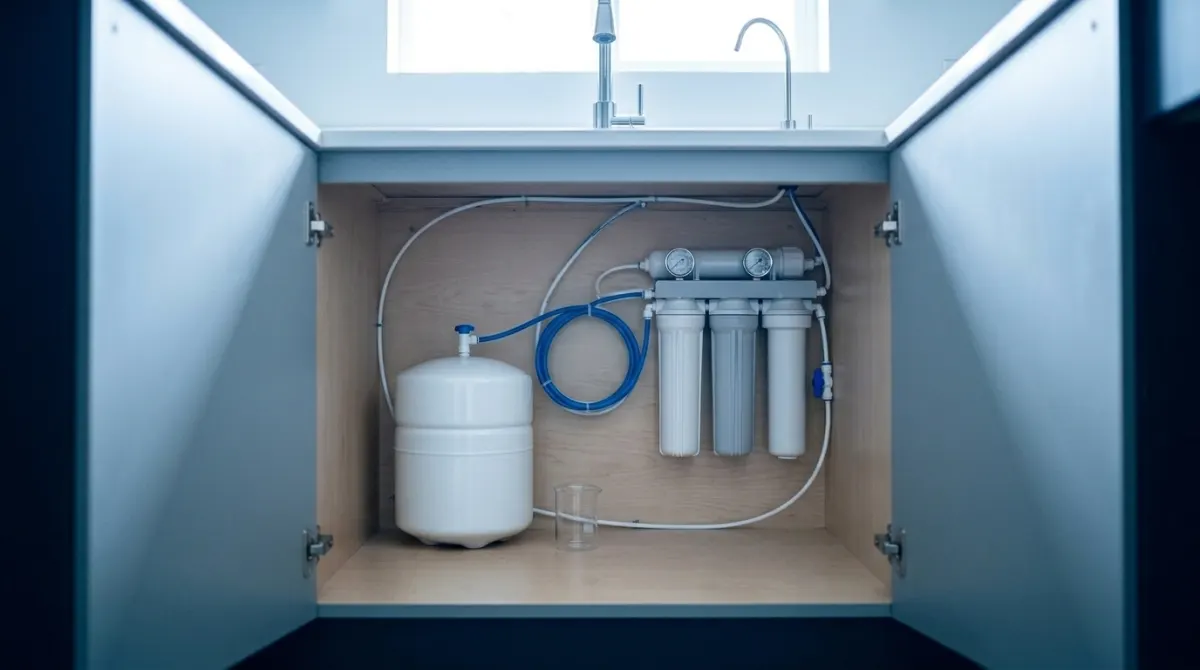
A tankless point-of-use reverse osmosis system that mounts under the kitchen sink and produces filtered water on demand — no pressurized storage tank eating cabinet space. Waterdrop rates it at 800 gallons per day (GPD), which the company illustrates as filling a 6-ounce cup in about five seconds. The RO membrane carries a published pore size of 0.0001 μm, which is the layer doing the heavy reduction work on dissolved solids. It is a drinking-and-cooking-water system for one tap — not whole-house coverage.
We earn nothing if you buy through this link — the manufacturer sells it directly and we are not in their programme.
The numbers that decide it
| Checkpoint | G3 P800 (per Waterdrop) | Our read |
|---|---|---|
| Rated output | 800 GPD | High end of the tankless category — never waits on a tank |
| Pure-to-drain ratio | 3:1 (3 cups pure per 1 to drain) | Efficient — read the ratio direction when comparing |
| Certification | NSF/ANSI 58 & 372; IAPMO R&T to 42 & 53 per Performance Data Sheet | Named third-party certification — strong for the category |
| UV sterilization | UV-LED, 99.9% rate (UV-equipped variant) | Confirm your exact model includes it |
| Membrane | 0.0001 μm RO; reduces 1,000+ substances incl. PFOA/PFOS, fluoride, lead, arsenic, nitrate | Check the Performance Data Sheet for certified vs. tested claims |
| Filter schedule | Pre-filter ~6 mo ($29.99), carbon block ~12 mo ($29.99), membrane ~24 mo ($129.99) | Roughly $60/yr amortized — mid-pack for tankless |
| Typical street price | ~$400–$600 (varies by configuration) | UV and remineralization variants cost more |
Specifications above are from Waterdrop's published product information. Verify the current GPD, certification scope, contaminant list, and replacement schedule for the exact configuration you are buying at waterdropfilter.com and nsf.org/certified-products — Waterdrop sells the G3P800 in standard, remineralization, alkaline, and UV builds, and the spec sheet differs between them.
The pure-to-drain ratio, read correctly
This is the spec most often quoted wrong. Older tank RO systems are usually described as wasting 3 to 4 gallons to drain for every gallon of pure water— that is a drain-to-pure ratio. Waterdrop publishes the G3 P800's figure the other way around: a 3:1 pure-to-drain ratio, meaning three parts filtered for every one part sent to drain. Same kind of number, opposite direction — and a genuinely efficient result for an under-sink RO. When you compare it to a competitor that quotes "3:1," confirm which direction each brand is measuring before you conclude they are equal. They frequently are not.
Certification: what 58 & 372 actually cover
Waterdrop publishes NSF/ANSI 58 (reverse osmosis contaminant reduction) and NSF/ANSI 372(low-lead material content) for the G3P800, and states IAPMO R&T certification to NSF/ANSI 42 and 53for the claims on the model's Performance Data Sheet. That is a meaningful distinction from brands that "test to" a standard without a named certifying body. The practical move: pull the Performance Data Sheet for your configuration and confirm which specific contaminants — particularly PFOA and PFOS if that is your concern — are listed under a certification claim versus a general "tested to reduce" statement. The certification is real; the scope is what you verify.
Install and maintenance reality
The G3 P800 is built for DIY: twist-in filter cartridges, a single feed-water adapter, and a designated drain connection. The tankless design is the headline maintenance advantage — no pressurized storage tank means no stagnant-water bacterial risk if you fall behind on membrane changes, and no 3-to-5-gallon tank consuming the cabinet. The trade is that the unit needs an electrical outlet under the sink (the booster pump and, on the UV build, the UV-LED both draw power), so plan for that during install. The on-unit display tracks filter life on each of the three cartridges and prompts replacement on Waterdrop's staggered 6 / 12 / 24-month schedule.
G3 P800 vs the Aquasana SmartFlow
Our top under-sink pick remains the Aquasana SmartFlow RO (87/100, BUY), and the reason is narrow and specific: Aquasana names PFOA and PFOS reduction directly in its certified contaminant claims. If a documented PFAS problem is what sent you shopping, that named certification is the deciding spec. The G3 P800 lists PFOA/PFOS among the 1,000-plus substances its membrane reduces, but you should confirm on the Performance Data Sheet whether those specific compounds fall under a certification claim for your configuration.
Where the G3 P800 pulls ahead is raw throughput and efficiency: 800 GPD against the SmartFlow's lower rated output, the published 3:1 pure-to-drain ratio, and an optional UV-LED stage the SmartFlow doesn't offer. For a household that prioritizes a fast-recovering tankless and broad reduction over a single named PFAS certification, the G3 P800 is the better-flowing machine. The full three-way breakdown — including the budget iSpring tank option — is in our best under-sink RO comparison.
Who shouldn't buy it
Anyone wanting whole-house coverage. This is one tap. Shower, laundry, and outdoor water are untouched. For household-wide chlorine and taste reduction, the RO belongs downstream of a whole-house carbon filter like the SpringWell CF1, with the G3 P800 as the certified endpoint at the kitchen tap.
Buyers who can't add an outlet under the sink. The pump-driven tankless design needs power. If your sink cabinet has no nearby outlet and running one isn't practical, a non-electric tank RO is the simpler path.
Anyone who wants minerals left in. RO rejects calcium and magnesium along with contaminants. If remineralized water matters to you, order the G3P800 remineralization or alkaline configuration rather than the standard build.
Verdict — 86/100
BUY for a high-efficiency tankless RO. 800 GPD, a published 3:1 pure-to-drain ratio, and named NSF/ANSI 58 & 372 certification make the spec sheet hold up.
PFAS your specific concern? The Aquasana SmartFlow names PFOA/PFOS in its certified claims and stays our top pick for that case. Want the full three-way math? Best under-sink RO, settled on specs.
Questions buyers actually ask
Is the Waterdrop G3 P800 NSF certified?
Yes. Waterdrop's published specifications for the G3P800 list NSF/ANSI 58 and NSF/ANSI 372 certification — 58 covers reverse osmosis contaminant reduction and 372 covers low-lead material content. Waterdrop also states the system is certified by IAPMO R&T to NSF/ANSI 42 and 53 for the claims specified on its Performance Data Sheet. Certification scope and the specific contaminant list are published on the model's Performance Data Sheet; verify the current listing at waterdropfilter.com and nsf.org/certified-products before purchasing, since certifications are updated periodically.
How much water does the Waterdrop G3 P800 waste?
Waterdrop publishes a 3:1 pure-to-drain ratio for the G3P800 — for every three cups of filtered water produced, roughly one cup goes to drain. This is the inverse of how traditional tank RO systems are usually described (where the older convention quotes 3–4 gallons to drain per gallon of pure water), so read the ratio direction carefully when comparing models. The 3:1 pure-to-drain figure is among the more efficient ratios published in the tankless under-sink category.
Does the Waterdrop G3 P800 have a UV light?
The G3P800 is offered in a configuration with an integrated UV-LED sterilizing light, which Waterdrop rates at a 99.9% UV sterilization rate and which uses LED technology rather than a mercury UV lamp. UV is a feature of the UV-equipped variant — confirm that the specific model you are ordering includes the UV-LED stage, as Waterdrop sells the G3P800 platform in multiple configurations (standard, remineralization, alkaline, and UV) at waterdropfilter.com.
How often do you replace Waterdrop G3 P800 filters?
Per Waterdrop's published schedule, the G3P800 uses three replaceable cartridges on staggered intervals: the combined sediment/carbon-block pre-filter roughly every 6 months, the activated-carbon block roughly every 12 months, and the RO membrane roughly every 24 months. Published replacement prices at the manufacturer are approximately $29.99 for the pre-filter, $29.99 for the carbon block, and $129.99 for the membrane. Actual life varies with usage volume and incoming water quality; the system's display tracks filter life and prompts replacement.
We earn nothing if you buy through this link — the manufacturer sells it directly and we are not in their programme.