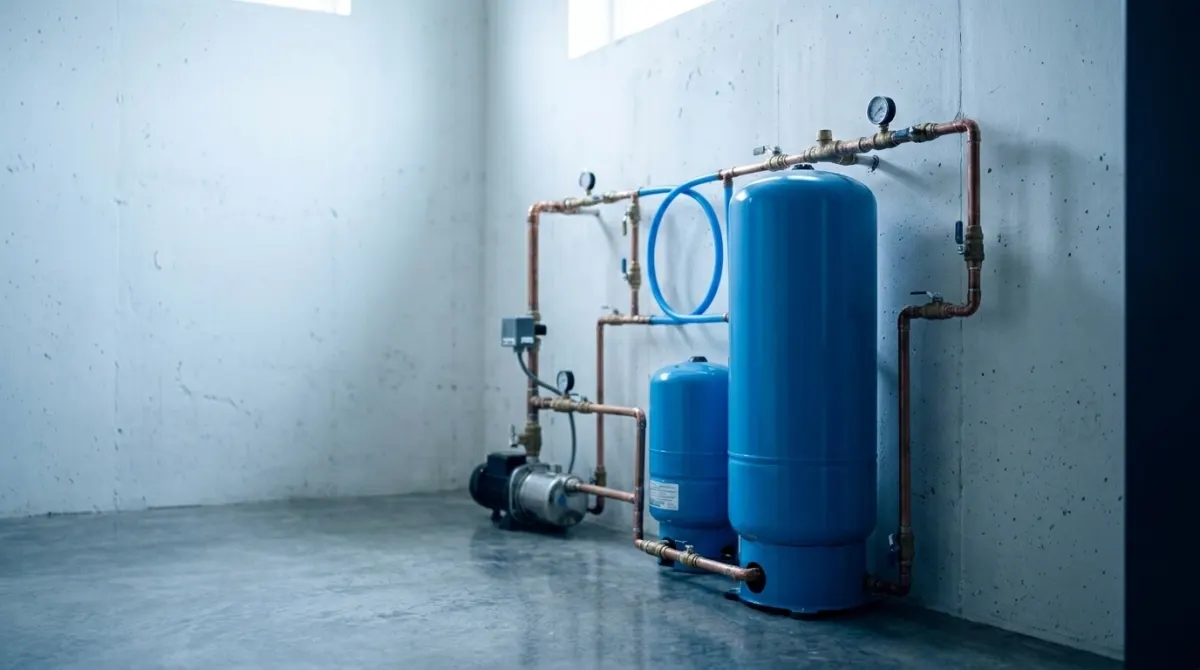
Well & Pumps
Pressure Switch for a Well Pump: Settings and Bad-Switch Signs
The cheapest part in the system and one of the most common causes of a no-water call. Here's what it does, standard settings, and how to tell it apart from a bad pump or tank.
By Tim Parker — Reads the spec sheets and prices the full install
A pressure switch for a well pump is a small mechanical box that turns system pressure into a start/stop signal — it's the cheapest part in the whole well system, and a large share of "no water" calls trace back to it rather than the pump.
This page focuses specifically on the switch and, most usefully, on telling it apart from a bad pump or a waterlogged tank — the three produce genuinely overlapping symptoms. For the pump itself see the well pump guide; for the tank, see the well pressure tank guide; or start at the well pump & pressure tank hub.
What the switch does
Mounted on a tee near the pressure tank, the switch holds a diaphragm connected to system water pressure, a spring, and a pair of electrical contacts. As pressure drops with use, the diaphragm moves and eventually lets the spring close the contacts, starting the pump at cut-in. As pressure climbs back up, the diaphragm pushes the other way and opens the contacts at cut-out, stopping the pump. It is a purely mechanical translation of pressure into an electrical signal — no electronics, which is part of why it's both cheap and prone to wear.
Standard cut-in / cut-out settings
Most residential systems run one of three industry-standard pairs: 30/50, 40/60, or 50/70 psi. The pair chosen has to match both the pump's curve and the pressure tank's rating — the tank's precharge is set relative to whichever cut-in is selected, roughly 2 psi below it with the system drained. Pushing cut-out higher than what the tank and pump curve support doesn't deliver meaningfully better pressure at the tap; it just shortens the life of both components by running them outside their rated range.
Which switch to buy: the two decisions
Once you know the fault really is the switch, only two things pick the part. The first is the pressure pair, and the rule is that you match the switch to the tank you already have, not the other way round — the tank's precharge is set about 2 psi below cut-in, so a switch with a different cut-in than the one the tank was charged for means recharging the tank as part of the job. The second is whether the switch has a low-pressure cut-off. On the Square D 9013FSG bodies below that is the entire difference between the two model numbers: the M4 suffix is the cut-off, and per the manufacturer's own listing it operates roughly 10 psi below cut-in. If your well can be drawn down faster than it recovers, that is the feature that stops the pump instead of letting it run dry. Both switches below are NEMA 1 with a 15–30 psi adjustable differential and a 20–65 psi cut-out range, so either can be trimmed on the spring nuts once it's on the tee.
The 30/50 with the cut-off is the one to buy if your system runs the 30/50 pair and the well is one that can be pumped down. Amazon's listing describes it as diaphragm-actuated and rated for water or air, used to control electrically driven motors.
The 20/40 is the same body without the cut-off, and it is the right part for a like-for-like swap on a system already set up and precharged for the 20/40 pair. Buying it to replace a 30/50 switch means dropping the tank precharge to suit — which is work, and a reason to match what you have rather than change bands casually.
The differential diagnosis: switch, pump, or tank
This is the genuinely useful part. All three components sit in series and a fault in any one of them can look like a fault in another — which is exactly why replacement parts get bought that didn't need replacing. Match the symptom against all three columns before ordering anything.
| Symptom | If it's the switch | If it's the pump | If it's the tank |
|---|---|---|---|
| No water, breaker holding, pump silent | Contacts pitted or welded open — circuit never closes | Seized motor or failed capacitor — draws power, doesn't turn | Not a tank symptom on its own |
| Pressure swings wildly, doesn't hold a steady band | Worn diaphragm or clogged sensing line — reads pressure late | Uncommon on its own — pumps don't usually cause erratic swings | Lost precharge shrinks the buffer, amplifying every swing |
| Rapid short cycling, on and off every few seconds | Contacts arcing on rapid cycles, but usually a downstream symptom | Not the root cause — pumps rarely cause cycling on their own | Waterlogged bladder — by far the most common actual cause |
| Pump runs, but cuts out well below the expected pressure | Cut-out contacts miscalibrated or worn | Worn impeller delivering less head than the curve rated it for | Not typically a tank symptom |
A diagnostic starting point, not a substitute for a licensed contractor confirming the fault with a meter and pressure gauge before anything is replaced.
Burnt contacts and clogged sensing lines
Every switch cycle involves a small electrical arc as the contacts close and open — normal and unavoidable, but cumulative. Over enough cycles the contacts pit, and eventually weld shut or fail to close at all. A system stuck short-cycling from a bad tank runs through far more cycles per day than a healthy one, which is why a waterlogged tank frequently takes out the switch with it if it goes unfixed. The small nipple or sensing port feeding pressure to the switch is also a common failure point on well water: iron and scale clog it over time, and a clogged sensing line makes a perfectly good switch read pressure late or not at all — behaving exactly like a failed switch even though the diaphragm and contacts are fine.
Replacing a switch: what the job actually involves
Physically, a switch swap is simple: kill power, drain pressure, disconnect the wiring after noting which terminal each wire came from, unscrew the old switch from the tee, thread on the new one with fresh pipe sealant, reconnect the wiring, restore power, and let the system cycle through a full fill to confirm cut-in and cut-out land where expected. The part that trips people up isn't the mechanical swap — it's setting cut-in and cut-out afterward if the replacement switch's factory setting doesn't match the old one, which requires small adjustments to the switch's internal spring nuts while watching a pressure gauge through a full cycle. Guessing at that adjustment, or copying a setting from an unrelated system, is how a fine replacement switch ends up running a pump or tank outside their rated range.
Because the differential diagnosis above matters more than the swap itself, the real cost of a service call is usually the diagnostic time — confirming it's genuinely the switch and not the tank or pump — not the part, which is inexpensive on its own. See what it really costs for sourced figures rather than a guess made here.
The safety reality: this is a live 240V component
Most residential well pumps run on a 240V circuit, and the pressure switch sits directly on it. Opening the switch cover with the breaker still on is a real shock and arc-flash risk, not a theoretical one. Kill the breaker, confirm the circuit is dead with a meter rather than assuming it, and only then open the cover. If reading a wiring diagram and confirming dead power with a meter isn't something you're confident doing, this is a licensed electrician or well contractor's job, not a weekend one.
Common questions
What does a pressure switch for a well pump actually do?
It's a small box, usually mounted on a tee near the pressure tank, holding a diaphragm, a spring, and a set of electrical contacts. It senses system pressure and closes the circuit to start the pump at cut-in, then opens it to stop the pump at cut-out. It is the component that turns pressure into a start/stop signal for everything else in the system.
What are standard pressure switch settings?
Most residential well systems run one of three standard pairs — 30/50, 40/60, or 50/70 psi (cut-in/cut-out) — and these are industry-standard conventions, not brand-specific figures. The right pair for a given house depends on the pressure tank's rating and the pump's curve; raising cut-out past what either is rated for shortens their life without meaningfully improving water pressure at the tap.
How do I tell if the switch is bad, or if it's the pump or the tank?
Watch the pressure gauge through a complete cycle. If the pump runs and pressure climbs normally but the switch never cuts out, or never cuts back in until pressure has dropped far below the set point, the switch itself is the likely fault. If the pump doesn't run at all despite voltage reaching the switch, suspect the pump or its control box. If everything cycles correctly but far too often, check the tank's precharge before touching the switch — a waterlogged tank is the more common cause of that symptom by a wide margin.
What causes a burnt or pitted pressure switch?
The contacts arc a small amount on every single cycle, and that arcing pits and eventually welds or corrodes them over enough cycles — which is exactly why a system that's short-cycling from a bad tank also tends to kill its switch early. Corrosion and mineral buildup in the small sensing port that feeds the switch has the same practical effect: a good switch reading bad pressure behaves exactly like a failed one.
Is it safe to work on a well pump pressure switch myself?
The switch sits on a live circuit that, on most residential wells, is 240V — a serious shock and arc-flash hazard, not a minor one. Cutting power at the breaker before opening the switch cover is non-negotiable, and confirming the circuit is dead with a meter, not by assumption, is the only safe way to proceed. If you are not confident reading a wiring diagram and confirming dead power yourself, this is squarely a licensed electrician or well contractor's job.
Keep going
Traced it to a waterlogged tank instead? Well pressure tank guide. Switch and tank both check out? Well pump guide. Cost of getting a contractor out to diagnose it? What it really costs.