Well & Pumps
Well Pressure Tank: Drawdown, Precharge and Waterlogging Signs
A correctly sized, correctly charged pressure tank is what stops your well pump from short-cycling itself to death. Here's the honest reason it matters.
By Tim Parker — Reads the spec sheets and prices the full install
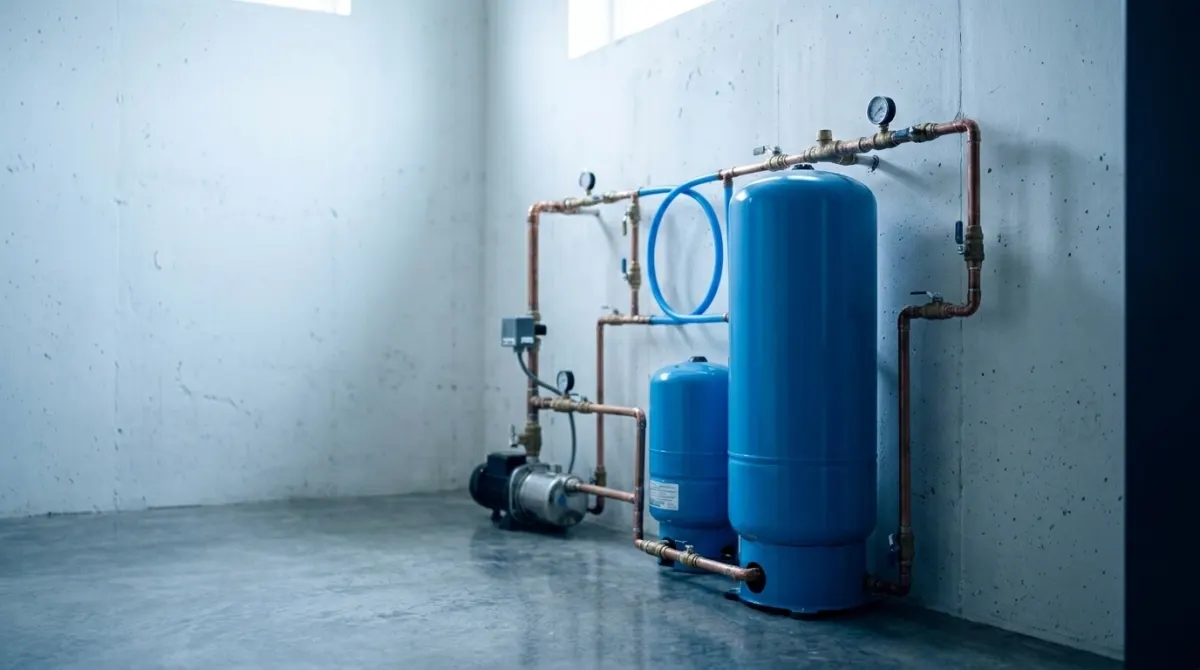
A well pressure tank is a sealed steel vessel split by a rubber bladder, water on one side and compressed air on the other. That air charge is a spring: it's the only thing standing between a healthy pump and one that starts hundreds of times a day until it fails.
This page is about the tank specifically. For the pump itself, see the well pump guide; for the part that starts and stops the pump, see pressure switch for well pump; or start at the well pump & pressure tank hub for how all three fit together.
The honest reason to care about the tank at all
Without a pressure tank, opening a single tap would fire the pump immediately, and closing it would stop the pump immediately — a well pump forced to start and stop dozens of times an hour wears out its motor windings and switch contacts far faster than one running normal, spaced-out cycles. The tank's job is to absorb small draws entirely from stored pressure, so the pump only starts when that stored reserve is genuinely used up. A pump paired with a correctly working tank might cycle a handful of times a day under normal household use; paired with a failed tank, it can cycle every few seconds. That difference in cycle count, not the horsepower or the brand, is what actually determines how long a pump lasts.
Drawdown vs. total volume — the number that's routinely confused
Total volume is simply the tank's physical size — a 20-gallon tank holds 20 gallons of combined air and water. Drawdown is something else entirely: it's the usable water that actually cycles between cut-in and cut-out, and it's always a fraction of total volume because most of the tank stays permanently occupied by the compressed air charge, even at cut-out. Conflating the two is a genuinely common and consequential error — a buyer comparing tanks on total volume alone can end up with a tank that delivers noticeably less usable capacity than expected, and short-cycles sooner than the "gallon" number on the box implied. Manufacturer spec sheets publish drawdown at a stated pressure range; that's the number to compare, not the tank's overall size.
How precharge relates to the pressure switch's cut-in
The tank's air precharge and the pressure switch's cut-in setting are not independent numbers — they have to be set in relation to each other, and getting that relationship wrong shrinks usable drawdown even on a perfectly good tank. Standard practice sets precharge about 2 psi below cut-in, checked with the system drained so there's no water pressure pushing back on the reading. Set precharge too high, at or above cut-in, and the bladder gets pinned to one side before the pump even starts, leaving almost no volume left to draw down before cut-out arrives again. Set it too low, and the bladder over-expands into the water side, which accelerates wear on the bladder itself. Most residential systems run a standard pressure pair — 30/50, 40/60, or 50/70 psi — and the precharge follows whichever cut-in the switch is set to.
Symptoms of a waterlogged tank
A waterlogged tank is the single most common cause of well-system short cycling — well ahead of a genuinely failed pump. Work through these before assuming the expensive part is at fault.
| Symptom | Likely cause | How to check |
|---|---|---|
| Pump clicks on and off every few seconds at a single tap | Bladder has failed — tank is waterlogged, no air cushion left | Tap the tank's side: uniform solid sound top to bottom means it's full of water, not air over water |
| Pressure gauge needle barely moves between cycles | Precharge lost or set too close to cut-in, shrinking usable drawdown | Drain the system, check air pressure at the tank's schrader valve against the switch's cut-in setting |
| Water sprays from the tank's air valve when pressed | Bladder has ruptured — water is in the air chamber | No further diagnosis needed; the tank needs replacement |
| System held pressure fine for years, now cycles constantly | Gradual precharge loss through the bladder over time, or a slow leak elsewhere | Check precharge before assuming the pump has failed — this is the more common cause by far |
A diagnostic guide, not a substitute for a licensed well contractor — especially before any work near a live 240V well circuit.
Sizing the tank
A larger tank means fewer pump starts per day for the same household draw, because more drawdown is available before cut-out is reached. Undersizing a tank for a household's actual peak draw is a common way to reintroduce short cycling on an otherwise healthy system — the tank isn't broken, it's just too small for the demand placed on it. Real installed cost figures live on what it really costs; no price is quoted on this page.
A useful way to think about sizing is pump cycles, not gallons. A given tank's drawdown, the pump's flow rate, and the household's typical simultaneous draw together determine how many times per hour the pump starts under normal use. A tank sized correctly for the pump keeps that number low and spaced out; a tank sized for a smaller pump paired with a larger one keeps cycling frequent even with a perfectly healthy bladder, because the pump simply refills the available drawdown too fast for the tank to smooth it out. This is why tank and pump are specified together during a replacement, rather than the tank being an afterthought bought on gallon count alone.
Checking precharge without guessing
Checking precharge correctly means shutting the pump off at the breaker, opening a tap to fully drain system pressure to zero, and only then reading the schrader valve on top of the tank with a standard tire gauge. Reading it under any residual water pressure gives a false high number, because the water side is still pushing back against the air side through the bladder. If the reading sits meaningfully below the target — roughly 2 psi under cut-in — a bicycle-style hand pump or a small air compressor restores it, provided the bladder itself isn't the thing that failed. If the tank won't hold air at all after refilling it, or air comes back out mixed with water at the valve, that's a ruptured bladder, and no amount of re-pressurizing fixes it.
Common questions
What does a well pressure tank actually do?
It stores a cushion of water under compressed air so the pump doesn't have to start every time a tap opens. Without it, the pump would fire on and off almost continuously — that rapid starting is what a correctly sized, correctly charged tank exists to prevent.
What is the difference between drawdown and total tank volume?
Total volume is the physical size of the tank — a 20-gallon tank holds 20 gallons. Drawdown is the much smaller usable amount that actually cycles out between cut-in and cut-out, because most of that volume is permanently occupied by the compressed air charge. Shoppers routinely compare tanks by total volume and end up with far less usable capacity than they expected; drawdown is the number that predicts how often the pump starts.
What should the precharge be set to?
Standard practice sets the tank's air precharge about 2 psi below the pressure switch's cut-in setting, checked with the system fully drained and no water pressure on the tank. If precharge sits above cut-in, the bladder is pushed to one side of the tank and delivers almost no usable drawdown even though the tank isn't waterlogged.
How do I know if my pressure tank is waterlogged?
Tap the tank at several heights: air over water sounds hollow near the top and solid near the bottom, while a waterlogged tank sounds uniformly solid everywhere because it's full of water top to bottom. Rapid short cycling and a bladder that fails to hold air on the schrader valve are the other two classic signs.
Can a pressure tank be repaired instead of replaced?
A lost precharge can be restored with a bicycle-style pump at the schrader valve, tank drained first — that's a real fix if the bladder itself is intact. A ruptured or waterlogged bladder cannot be repaired in a residential tank; the tank is replaced as a unit.
Keep going
Suspect the switch instead of the tank? Pressure switch for well pump. Tank's fine but the pump seems weak? Well pump guide. Choosing between shallow, deep, and submersible? Shallow vs. deep well pumps.